The idea of the one can hide several practical questions: do you share values, treat each other well and want a compatible future? This spread focuses on those questions rather than declaring a person your destined partner.
For reflection and entertainment. Tarot and AI readings don't predict the future and aren't financial, medical, legal or psychological advice. Use them as a prompt to think, not as a decision.
Is he the one? Draw your three cards
Free, no signup. Three distinct cards are drawn at random from the full 78-card deck. Each has a one-in-three chance of appearing reversed.
This random draw does not establish an outcome, reveal another person’s private thoughts or give a date. Use it as a prompt; check facts separately.
The three positions for this question
Set these positions before drawing. Read each card through its position instead of applying the same meaning to all three.
1. Values you share
Use this symbol to identify a value you need in a relationship. Which shared actions support it rather than only shared interests or attraction?
2. Compatibility to examine
Read this card as a prompt about daily compatibility: money habits, time, independence, conflict and plans. Where do you need more information?
3. A conversation about the future
Use the symbol to prepare a conversation about expectations. What future do you each want, and where might those plans diverge?
Keep this question in focus
Chemistry is an experience; compatibility is something you learn through choices and everyday life. A relationship can feel intense while important values conflict. Use this reading to identify what to discuss, not to override concerns with a soulmate label.
A complete example for “Is he the one?”
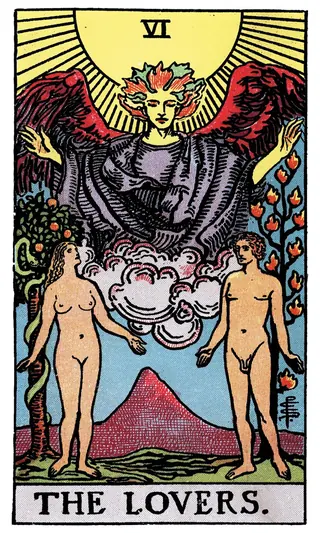
Values you share
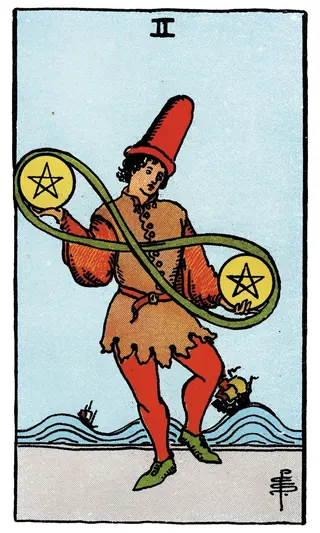
Compatibility to examine
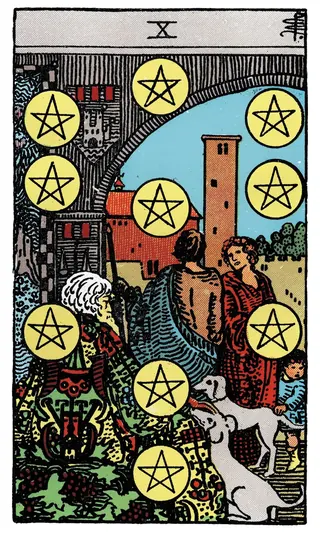
A conversation about the future
Pamela Colman Smith · Rider–Waite–Smith (1909)
These three upright cards are selected as an instructional example, not presented as a random draw or a recorded personal reading. Your own cards may differ; the method is to connect the symbol, position and context.
1. Values you share — The Lovers
The Lovers brings values and choice into focus. It is a good prompt to compare what matters to both of you, not a certificate of destiny.
2. Compatibility to examine — Two of Pentacles
The Two of Pentacles suggests balancing everyday demands. Discuss how the relationship fits work, friends and independent time.
3. A conversation about the future — Ten of Pentacles
The Ten of Pentacles raises long-term arrangements. A useful conversation might cover home, family expectations and the kind of stability each person wants.
Put the example together
Connect values you share with compatibility to examine, then use a conversation about the future to identify something you can examine or do. Look for a shared theme and a tension between the cards. If a connection does not fit what you know, do not force it.
Try an alternative interpretation as well. A card about holding on could describe useful stability or fear of change; decide which fits the evidence rather than selecting the version you prefer.
How to read a reversal here
A reversed card uses the reversed keywords shown in your result. Read those themes through the same position. It does not automatically negate the upright card or turn the whole spread into a no. A theme of hesitation, for example, can prompt a question about your own uncertainty without identifying another person’s motive.
Learn more about reversed tarot cards. Use the full card meaning as context, not as a substitute for the facts of your situation.
Cards traditionally linked to “he could be the one”
Readers asking whether a partner is the one tend to celebrate cards of commitment, balance and shared future. Here is how ten of them are traditionally read in a relationship context.
| Card | Why readers see it as encouraging here |
|---|---|
| Two of Cups | a partnership of equals, with care flowing both ways. |
| The Lovers | deep alignment of values, the card most people hope to see for this question. |
| Ten of Cups | a shared picture of home and family that feels emotionally settled. |
| Four of Wands | celebration and a stable foundation, often tied to moving in or getting engaged. |
| The Hierophant | commitment that is made public, along with shared traditions and rituals. |
| Temperance | patience and compromise, the everyday skills that keep a couple steady. |
| King of Cups | emotional maturity: a partner who stays calm when feelings run high. |
| The Empress | nurturing and mutual care that lets both people grow. |
| The World | a sense of wholeness, as if a long search has come to a natural close. |
| Ten of Pentacles | long-term security built together, from finances to family ties. |
These cards describe qualities to look for. They are best used as a checklist against your real relationship, not as a stamp of destiny.
Cards that ask you to look harder before deciding
These cards do not declare that he is the wrong person. They mark places where readers traditionally advise a closer look before you call a relationship forever.
- The Devil: a powerful pull that can feel like fate but may be attachment or control.
- The Tower: a sudden crack in an illusion; something you assumed may not be solid.
- Five of Wands: constant friction, where every small disagreement turns into a contest.
- Seven of Cups: idealizing a partner and picturing who he could be instead of who he is.
- Five of Swords: arguments won at a cost, a sign to check whether respect is mutual.
- Eight of Swords: feeling boxed in, even if the restrictions are partly self-imposed.
- Two of Swords: avoiding a big conversation, such as children, money or where to live.
- Three of Swords: grief or betrayal that has not been worked through.
- Knight of Swords: rushing toward commitment before you know each other well.
It is worth knowing that Death often frightens people in this reading, yet it is traditionally read as transformation: an old version of the relationship ending so a more honest one can begin.
Reading a mixed “is he the one” spread
Long-term questions often produce spreads that pull in two directions. Consider Two of Cups, The Devil and Temperance drawn together.
The Two of Cups opens with mutual affection, a genuine bond. The Devil follows with intensity that can tip into dependency, jealousy or a feeling that you cannot imagine life apart. That second card does not cancel the first; it asks whether the connection is freely chosen or held in place by fear. Temperance then suggests the answer lies in balance, in slowing down and letting the relationship prove itself over time rather than in one dramatic leap.
Read together, these three cards describe love that is real but needs healthier footing before it can be called a lifelong match. In any mixed draw for this question, notice which card speaks about everyday behavior. That card is usually the one you can test, and the test will tell you more than the most romantic image in the spread.
How long before you know he is the one?
No card measures how long it takes to recognize a lasting partner. Some readers borrow a traditional scheme that links Wands with days or weeks, Swords with weeks, Cups with months and Pentacles with a year or more, but readers disagree on the details. Use it as a story about pace, not a countdown.
The Hanged Man in this reading is often taken as a sign to wait and observe, while Wheel of Fortune hints that circumstances, not just feelings, will shape the next turn.
In practice, people learn whether a partner is right for them by watching him across different seasons of life: under stress at work, during an illness, around your family, when money is tight, after a serious argument. If the kindness and respect you see in easy months survive the hard ones, that is stronger evidence than any timing card. If you keep explaining away the same problem, give that pattern serious weight. Couples who last usually have small, ordinary proof of it long before any big moment.
What to do after asking if he is the one
- List three values that are non-negotiable for you, then note a concrete example of how he lives each one.
- Have the practical conversations early: children, money, where you want to live, faith, how you each handle conflict.
- Notice how you feel in his company: relaxed and like yourself, or watchful and smaller.
- Ask one or two trusted friends what they have observed, and listen without arguing.
- Before a major commitment, consider premarital or couples counseling; it is a tool for strong couples too.
Once you have drawn on this question, put the cards away until something real changes. Asking the same thing every few days only feeds doubt. If you would like to explore a related angle, the will he commit spread asks something different. When fear of choosing wrong keeps you awake or frozen, a licensed therapist can help you separate old wounds from present facts.
Practical checks after this reading
- Compare values with examples of how you both act.
- Discuss one everyday issue you have been avoiding.
- Keep your ability to leave a relationship separate from any spiritual label.
Record the cards, one possible interpretation and one fact that would help you evaluate it. If the draw does not fit, leave it aside. Repeating a draw until it feels reassuring does not make the result more informative.
Choose the question you actually mean
These related spreads examine different questions; one answer should not be used to settle the others.
More tarot readings by question
Love and attraction
- Does he like me?
- Does she like me?
- How does he feel about me?
- Is he thinking about me?
- Does he miss me?
- Will he text me?
- Should I text him?
- Will he commit?
- Will I find love?
- When will I meet my soulmate?
- Future husband tarot
- Will I get married?
Exes and second chances
- Will he come back?
- Will she come back?
- Does my ex still love me?
- Will my ex contact me?
- Will we get back together?
- Should I forgive him?
- Should I stay or leave?
Work, money and study
- Will I get the job?
- Will I get promoted?
- Should I quit my job?
- Should I change careers?
- Will my business succeed?
- Will my finances improve?
- Will I pass my exam?
Life decisions
Frequently asked questions
Can this reading answer “Is he the one?” with certainty?
The idea of the one can hide several practical questions: do you share values, treat each other well and want a compatible future? This spread focuses on those questions rather than declaring a person your destined partner.
How is this spread different from the other readings?
This spread uses values you share, compatibility to examine and a conversation about the future. Its worked example and practical checks focus on this question. It does not use a generic yes/no score.
Does typing my question change the interpretation?
No. The optional note is for your own context. Cards are drawn at random in your browser, and the prompts are written for the positions on this page. No AI analyses your note in this tool.
What should I do with an unclear or uncomfortable reading?
Record one possible interpretation and compare it with what you know. If it does not fit, you can leave it aside. Another draw cannot establish a missing fact; use a conversation, records or other relevant information instead.
Method and further reading
This tool uses the site’s Rider–Waite–Smith card keywords with question-specific reflection prompts. It does not analyse your optional note with AI, infer hidden information or calculate the likelihood of an outcome. The worked example explains how to apply the positions.
Learn to read a complete tarot spread · All 78 card meanings · How our tools work