This spread offers reflection on the pressure you feel, the information you need and a practical step toward understanding your situation. It cannot forecast income, debt, investment returns or luck. Use actual figures and suitable advice for financial choices.
For reflection and entertainment. Tarot and AI readings don't predict the future and aren't financial, medical, legal or psychological advice. Use them as a prompt to think, not as a decision.
Will my finances improve? Draw your three cards
Free, no signup. Three distinct cards are drawn at random from the full 78-card deck. Each has a one-in-three chance of appearing reversed.
This random draw does not establish an outcome, reveal another person’s private thoughts or give a date. Use it as a prompt; check facts separately.
The three positions for this question
Set these positions before drawing. Read each card through its position instead of applying the same meaning to all three.
1. The pressure you want to address
Use the symbol to describe the specific worry. Is the issue regular costs, irregular income, an obligation or uncertainty about what you owe?
2. The financial picture to clarify
Read this card as a prompt to gather actual information rather than infer a future. Which figures, terms or deadlines do you need to check?
3. A practical information step
Use the symbol to choose an information-gathering or support step. What question could you ask a suitable adviser or relevant provider?
Keep this question in focus
Improvement means different things: meeting regular bills, reducing uncertainty or planning for a goal. Name the issue before drawing. Avoid interpreting a card about abundance as evidence that money will arrive or that a risky choice will work out.
A complete example for “Will my finances improve?”
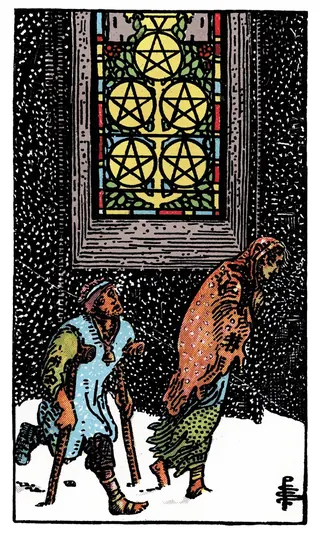
The pressure you want to address
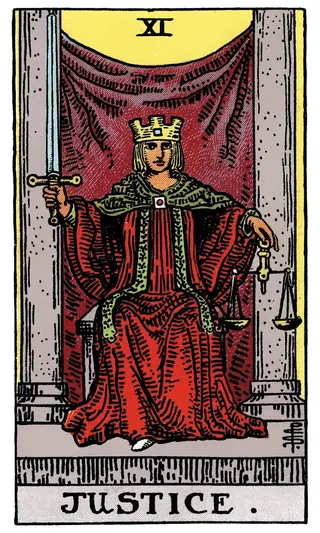
The financial picture to clarify
A practical information step
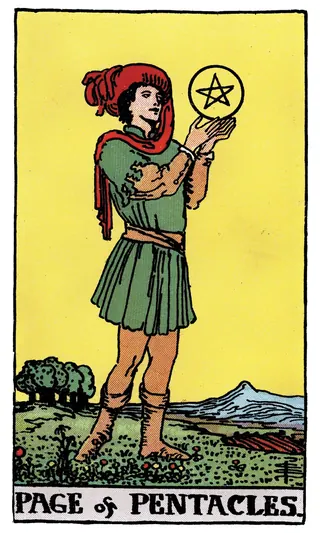
Pamela Colman Smith · Rider–Waite–Smith (1909)
These three upright cards are selected as an instructional example, not presented as a random draw or a recorded personal reading. Your own cards may differ; the method is to connect the symbol, position and context.
1. The pressure you want to address — Five of Pentacles
The Five of Pentacles can reflect a sense of shortage. It acknowledges the worry without predicting continued hardship.
2. The financial picture to clarify — Justice
Justice suggests looking carefully at terms and obligations. Make the picture clearer with real documents rather than relying on a symbolic balance.
3. A practical information step — Page of Pentacles
The Page of Pentacles suggests learning. A useful outcome is to identify the exact question you need help answering, not to expect a windfall.
Put the example together
Connect the pressure you want to address with the financial picture to clarify, then use a practical information step to identify something you can examine or do. Look for a shared theme and a tension between the cards. If a connection does not fit what you know, do not force it.
Try an alternative interpretation as well. A card about holding on could describe useful stability or fear of change; decide which fits the evidence rather than selecting the version you prefer.
How to read a reversal here
A reversed card uses the reversed keywords shown in your result. Read those themes through the same position. It does not automatically negate the upright card or turn the whole spread into a no. A theme of hesitation, for example, can prompt a question about your own uncertainty without identifying another person’s motive.
Learn more about reversed tarot cards. Use the full card meaning as context, not as a substitute for the facts of your situation.
Cards traditionally read as financial improvement
Most money-positive cards belong to the suit of Pentacles, which governs work, resources and the material world. Read them as themes to act on, never as proof that money is on the way or that a risky move will pay off.
- Ace of Pentacles: a new practical opportunity, such as extra work or a better rate.
- Nine of Pentacles: self-sufficiency earned through discipline.
- Ten of Pentacles: long-term stability and resources that last.
- Six of Pentacles: fair exchange; help offered or received without shame.
- Seven of Pentacles: patient effort beginning to show results.
- Eight of Pentacles: building a skill that can raise your earning power.
- Queen of Pentacles: grounded household management and a workable budget.
- King of Pentacles: financial maturity and steady decision-making.
- Four of Pentacles: saving and protecting what you have.
- Wheel of Fortune: a turning point; circumstances can shift.
- The Sun: relief and clarity once the numbers are faced openly.
Cards read as a money warning or a not-yet
A difficult money card is a prompt to protect yourself, not a forecast of ruin. These are traditionally read as pressure points that need attention.
- Five of Pentacles: hardship and isolation; a sign to ask for help rather than struggle alone.
- Ten of Wands: too many obligations carried at once.
- Seven of Cups: wishful thinking and too-good-to-be-true offers.
- Seven of Swords: deception; double-check anyone asking for money or account details.
- The Devil: debt traps, high-interest loans or compulsive spending.
- The Tower: a sudden expense or shock; build an emergency buffer.
- Nine of Swords: money anxiety that may be worse than the actual numbers.
- Two of Pentacles: juggling bills; a juggling act cannot last indefinitely.
- Eight of Swords: feeling trapped by debt when options may still exist.
- Five of Swords: a deal in which someone loses; read the terms carefully.
Reading a mixed money draw
Imagine drawing the Ace of Pentacles, The Devil and the Queen of Pentacles. An opportunity sits beside a trap, and the last card asks for grounded, everyday management. In real life this pattern often matches an offer that looks like a way out, such as a quick loan, a debt consolidation pitch or an investment promising fast returns, which could deepen the hole. The Queen suggests the better path is unglamorous: a clear budget and careful reading of terms.
The rule for any money draw, mixed or not, is that no card is permission for a financial risk. A promising card can show the attitude you need, not the outcome you will get. Sort the cards into what they say about your behavior, such as saving or spending, versus what they seem to say about luck. Act only on the first group. If the draw feels contradictory, that may simply reflect that your situation has both a real opportunity and a real risk in it, which is exactly when outside advice is most valuable.
When will things get better? What the cards can and cannot time
Readers sometimes say Pentacles move slowly while Wands bring quick change, or they link each suit to a season. These are symbolic conventions with no fixed rules, and they cannot tell you when a paycheck, refund or raise will arrive. Waiting for a card's season to fix your finances can cost you time you do not have.
Money timelines come from arithmetic, not symbols. List what you owe, the interest rate on each debt and the minimum payments, then estimate how many months each balance would take to clear at your current pace. That number is your real timeline, and it changes when you change the inputs. Track a few markers month to month: whether your balance is falling, whether you covered essentials without new borrowing, and whether you set aside even a small emergency amount. Three months of honest tracking will tell you more about improvement than any spread.
Real-world help after a money reading
This page does not give financial advice, and tarot cannot replace it. These steps point you toward people who can help.
- Gather your statements and write down every balance, rate and due date in one place.
- If debt feels unmanageable, contact a nonprofit credit counselor. The National Foundation for Credit Counseling, a nonprofit network of credit counseling agencies, can connect you with a certified counselor at 877-360-6322.
- Before you sign up anywhere, read the Consumer Financial Protection Bureau's guidance on choosing a credit counselor: get fees in writing, ask whether staff are paid more if you enroll, and check the organization with your state attorney general.
- Be wary of anyone who promises to erase debt quickly in exchange for an upfront fee.
Stop drawing on money once you have a written plan; check the plan, not the cards. If you are self-employed, the will my business succeed spread looks at the business side.
Real signs your finances are turning a corner
Improvement in money matters tends to be quiet and gradual. Good signs include balances that fall a little each month, essentials covered without new borrowing, bills paid on time, a small emergency amount that is growing, and less of your day spent worrying about money. Warning signs deserve attention just as much: borrowing from one card or lender to pay another, skipping food, medicine or rent to cover a payment, collection calls, or hiding purchases from a partner. Any of these is a reason to contact a credit counselor or a trusted adviser now rather than waiting for a better draw. Keep a simple monthly log of three numbers: total debt, savings and money left after essentials. Comparing those numbers over a season gives an honest answer to the question this page asks, and it is the kind of answer you can actually influence.
Practical checks after this reading
- Name the specific financial issue instead of asking about money in general.
- Check relevant figures, terms and deadlines.
- Seek appropriate help for decisions about debt, investment or other financial commitments.
Record the cards, one possible interpretation and one fact that would help you evaluate it. If the draw does not fit, leave it aside. Repeating a draw until it feels reassuring does not make the result more informative.
Choose the question you actually mean
These related spreads examine different questions; one answer should not be used to settle the others.
More tarot readings by question
Love and attraction
- Does he like me?
- Does she like me?
- How does he feel about me?
- Is he thinking about me?
- Does he miss me?
- Will he text me?
- Should I text him?
- Is he the one?
- Will he commit?
- Will I find love?
- When will I meet my soulmate?
- Future husband tarot
- Will I get married?
Exes and second chances
- Will he come back?
- Will she come back?
- Does my ex still love me?
- Will my ex contact me?
- Will we get back together?
- Should I forgive him?
- Should I stay or leave?
Work, money and study
- Will I get the job?
- Will I get promoted?
- Should I quit my job?
- Should I change careers?
- Will my business succeed?
- Will I pass my exam?
Life decisions
Frequently asked questions
Can this reading answer “Will my finances improve?” with certainty?
This spread offers reflection on the pressure you feel, the information you need and a practical step toward understanding your situation. It cannot forecast income, debt, investment returns or luck. Use actual figures and suitable advice for financial choices.
How is this spread different from the other readings?
This spread uses the pressure you want to address, the financial picture to clarify and a practical information step. Its worked example and practical checks focus on this question. It does not use a generic yes/no score.
Does typing my question change the interpretation?
No. The optional note is for your own context. Cards are drawn at random in your browser, and the prompts are written for the positions on this page. No AI analyses your note in this tool.
What should I do with an unclear or uncomfortable reading?
Record one possible interpretation and compare it with what you know. If it does not fit, you can leave it aside. Another draw cannot establish a missing fact; use a conversation, records or other relevant information instead.
Method and further reading
This tool uses the site’s Rider–Waite–Smith card keywords with question-specific reflection prompts. It does not analyse your optional note with AI, infer hidden information or calculate the likelihood of an outcome. The worked example explains how to apply the positions.
Learn to read a complete tarot spread · All 78 card meanings · How our tools work
Sources cited on this page:
- National Foundation for Credit Counseling · NFCC
- What is credit counseling? · Consumer Financial Protection Bureau