A promotion depends on your contribution and the organisation's criteria and opportunities. This spread helps you examine the case you can demonstrate, what needs clarification and how to have a useful progression conversation. It cannot forecast approval.
For reflection and entertainment. Tarot and AI readings don't predict the future and aren't financial, medical, legal or psychological advice. Use them as a prompt to think, not as a decision.
Will I get promoted? Draw your three cards
Free, no signup. Three distinct cards are drawn at random from the full 78-card deck. Each has a one-in-three chance of appearing reversed.
This random draw does not establish an outcome, reveal another person’s private thoughts or give a date. Use it as a prompt; check facts separately.
The three positions for this question
Set these positions before drawing. Read each card through its position instead of applying the same meaning to all three.
1. Contribution you can demonstrate
Use this symbol to identify results, scope and responsibilities you can document. What evidence shows readiness for the next level?
2. Criteria and opportunities to clarify
Read this card as a prompt about the actual process. Which criteria, openings, approvals or feedback are still unknown?
3. Your progression conversation
Use the symbol to prepare a specific request for feedback, expectations or a review point. What would a useful answer let you do next?
Keep this question in focus
Working hard and meeting promotion criteria are related but not identical. Find out what the next level requires, who decides and what evidence they need. If the process is unclear, asking for specific expectations is more useful than interpreting a card as management's secret view.
A complete example for “Will I get promoted?”
Contribution you can demonstrate
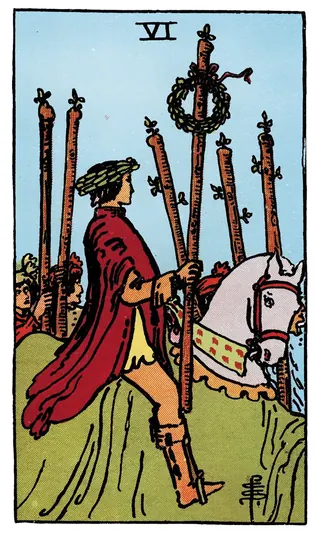
Criteria and opportunities to clarify
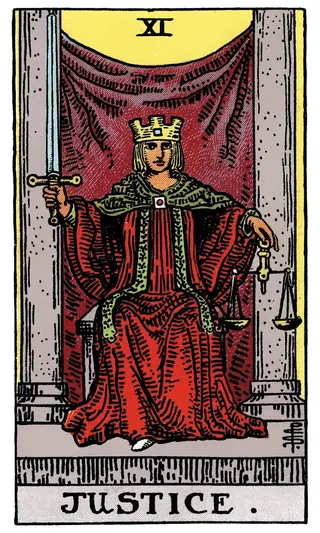
Your progression conversation
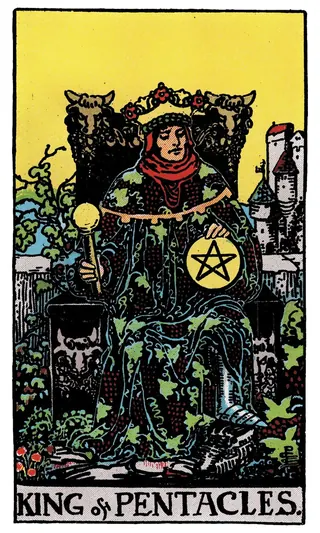
Pamela Colman Smith · Rider–Waite–Smith (1909)
These three upright cards are selected as an instructional example, not presented as a random draw or a recorded personal reading. Your own cards may differ; the method is to connect the symbol, position and context.
1. Contribution you can demonstrate — Six of Wands
The Six of Wands can symbolise recognition. In this position, gather examples of impact instead of taking the card as advance notice of a promotion.
2. Criteria and opportunities to clarify — Justice
Justice highlights criteria. Ask how promotion decisions are made and what evidence is considered.
3. Your progression conversation — King of Pentacles
The King of Pentacles suggests grounded planning. Present achievements and ask for a specific development plan, without treating seniority as something the cards can grant.
Put the example together
Connect contribution you can demonstrate with criteria and opportunities to clarify, then use your progression conversation to identify something you can examine or do. Look for a shared theme and a tension between the cards. If a connection does not fit what you know, do not force it.
Try an alternative interpretation as well. A card about holding on could describe useful stability or fear of change; decide which fits the evidence rather than selecting the version you prefer.
How to read a reversal here
A reversed card uses the reversed keywords shown in your result. Read those themes through the same position. It does not automatically negate the upright card or turn the whole spread into a no. A theme of hesitation, for example, can prompt a question about your own uncertainty without identifying another person’s motive.
Learn more about reversed tarot cards. Use the full card meaning as context, not as a substitute for the facts of your situation.
Cards traditionally read as favoring a promotion
Career readers tend to welcome these cards when the question is advancement. They point to recognition, skill and readiness, which are the ingredients a promotion decision weighs.
| Card | Why readers see it as positive for promotion |
|---|---|
| Six of Wands | Public recognition and a visible win that others acknowledge. |
| Three of Pentacles | Respected teamwork; your skills are noticed by people who matter. |
| Eight of Pentacles | Mastery through practice; a record of quality that builds your case. |
| Ace of Pentacles | A concrete new opportunity, often a role, raise or offer. |
| The Chariot | Drive and direction; you are steering toward the next level. |
| The Emperor | Authority and structure, frequently read as stepping into leadership. |
| King of Wands | Vision and initiative; others look to you to lead. |
| Three of Wands | Expansion and looking ahead; your scope is getting bigger. |
| Nine of Pentacles | Earned independence and the rewards of steady discipline. |
| The Sun | Visibility and success; your work is seen clearly. |
These cards describe strengths. Whether a role opens still depends on budgets, headcount and the people who decide.
Cards that suggest not yet or something to fix
A cautious card in a career spread is not a performance review. It usually points to a structural obstacle, a skill gap or a timing issue you can investigate.
- Ten of Wands: Overload; you may be carrying so much that nobody sees you leading.
- Four of Pentacles: A freeze on spending or headcount; the money may simply not be there.
- Seven of Pentacles: Results still ripening; the evaluation point may be later than you hoped.
- Five of Swords: Office politics or a win that costs relationships.
- Seven of Wands: Defending your position; competition for the same role.
- Two of Swords: A decision on hold, perhaps because leadership has not chosen yet.
- Page of Pentacles: Still learning; a skill to build before the next level.
- Five of Pentacles: Feeling left out in the cold; it may be time to look outside.
- Four of Swords: Burnout risk; rest may protect your performance more than overtime.
- The Hanged Man: A stall that asks you to see the situation from a different angle.
Read these as questions to raise with your manager, not as a final answer.
How to read a mixed promotion draw
Suppose you draw Eight of Pentacles, Seven of Pentacles and Knight of Wands. Skill, waiting and restlessness all at once.
A coherent reading: your craft is solid and your record is building (Eight of Pentacles). The organization may be in a waiting phase, perhaps tied to a review cycle or budget (Seven of Pentacles). The Knight of Wands shows impatience and the urge to move, which could mean pushing for an answer or exploring roles elsewhere.
The practical reading is to ask directly when the next evaluation window is and what would make you ready, then decide what you will do if the answer is vague. The restless card is not a command to quit. It is a signal that your patience has a limit worth naming. If the cards suggest leaving, compare with the should I quit my job spread before acting.
When will the promotion happen?
Readers apply suit conventions to career timing too: Wands quick, Cups weeks to months, Swords sudden, Pentacles slow and tied to resources. These are customs passed between readers, not reliable forecasts. Eight of Wands is often read as news arriving fast, while Knight of Pentacles suggests a slow, methodical path.
Your workplace usually has a real calendar that matters far more. Many organizations decide promotions during annual or twice-yearly review cycles, often after budgets are set. Ask your manager or HR when those windows are, how long before them a case is usually discussed, and whether an off-cycle promotion is possible.
If you have been told maybe next cycle more than once, that pattern is your timing information. It may be worth requesting written criteria or testing the outside market.
What to do after a will I get promoted reading
- Keep a running list of wins with measurable results: revenue, time saved, projects shipped, people trained.
- Ask your manager for the exact criteria for the next level and where you stand on each.
- Request one stretch responsibility that matches the level you want.
- Find a sponsor, someone senior who will speak for you when decisions are made.
- Agree a check-in date and follow up in writing.
- Look up market pay for the role so you know your options.
Stop asking the cards once you have a conversation scheduled; the meeting will tell you more. If work stress is affecting sleep or health, talk to a doctor or counselor, and if you suspect unfair treatment, an HR contact or employment attorney can explain your rights. More related reading: will I get the job, should I change careers and career chat.
Workplace signals that say more than the cards
Some of the clearest promotion signals are visible at your desk, not in a spread. Encouraging signs often include:
- You are asked to cover for your manager or lead meetings in their absence.
- Leaders invite you into planning conversations above your current level.
- Your manager discusses the next role with you in specific terms, including a timeline.
- You receive stretch projects with real visibility, not just more volume.
Signs that point the other way can be just as informative: feedback that stays vague, a role that keeps getting redefined, a newly hired person placed above you, or praise that never turns into scope or pay. None of these is final, and organizations change. Still, when the evidence at work and a hopeful card disagree, trust the evidence and use the card as a prompt to ask a clearer question in your next one-on-one.
Practical checks after this reading
- Document outcomes and responsibilities with examples.
- Ask what the next level requires and how readiness is judged.
- Agree a follow-up point and record the feedback you receive.
Record the cards, one possible interpretation and one fact that would help you evaluate it. If the draw does not fit, leave it aside. Repeating a draw until it feels reassuring does not make the result more informative.
Choose the question you actually mean
These related spreads examine different questions; one answer should not be used to settle the others.
More tarot readings by question
Love and attraction
- Does he like me?
- Does she like me?
- How does he feel about me?
- Is he thinking about me?
- Does he miss me?
- Will he text me?
- Should I text him?
- Is he the one?
- Will he commit?
- Will I find love?
- When will I meet my soulmate?
- Future husband tarot
- Will I get married?
Exes and second chances
- Will he come back?
- Will she come back?
- Does my ex still love me?
- Will my ex contact me?
- Will we get back together?
- Should I forgive him?
- Should I stay or leave?
Work, money and study
- Will I get the job?
- Should I quit my job?
- Should I change careers?
- Will my business succeed?
- Will my finances improve?
- Will I pass my exam?
Life decisions
Frequently asked questions
Can this reading answer “Will I get promoted?” with certainty?
A promotion depends on your contribution and the organisation's criteria and opportunities. This spread helps you examine the case you can demonstrate, what needs clarification and how to have a useful progression conversation. It cannot forecast approval.
How is this spread different from the other readings?
This spread uses contribution you can demonstrate, criteria and opportunities to clarify and your progression conversation. Its worked example and practical checks focus on this question. It does not use a generic yes/no score.
Does typing my question change the interpretation?
No. The optional note is for your own context. Cards are drawn at random in your browser, and the prompts are written for the positions on this page. No AI analyses your note in this tool.
What should I do with an unclear or uncomfortable reading?
Record one possible interpretation and compare it with what you know. If it does not fit, you can leave it aside. Another draw cannot establish a missing fact; use a conversation, records or other relevant information instead.
Method and further reading
This tool uses the site’s Rider–Waite–Smith card keywords with question-specific reflection prompts. It does not analyse your optional note with AI, infer hidden information or calculate the likelihood of an outcome. The worked example explains how to apply the positions.
Learn to read a complete tarot spread · All 78 card meanings · How our tools work