Business success needs a definition before it can be assessed. This spread helps you examine the value you aim to provide, an assumption that needs evidence and a practical test. It does not predict sales, profit or the survival of a business.
For reflection and entertainment. Tarot and AI readings don't predict the future and aren't financial, medical, legal or psychological advice. Use them as a prompt to think, not as a decision.
Will my business succeed? Draw your three cards
Free, no signup. Three distinct cards are drawn at random from the full 78-card deck. Each has a one-in-three chance of appearing reversed.
This random draw does not establish an outcome, reveal another person’s private thoughts or give a date. Use it as a prompt; check facts separately.
The three positions for this question
Set these positions before drawing. Read each card through its position instead of applying the same meaning to all three.
1. The value you aim to offer
Use the symbol to clarify whose problem you want to solve and what useful result the offer provides. What would a customer recognise as valuable?
2. An assumption to test
Read the card as a prompt to name an unproven assumption about demand, delivery, cost or reach. What evidence would support or challenge it?
3. The next evidence-gathering step
Use the symbol to design a small test with a measurable outcome. What can you learn before making a larger commitment?
Keep this question in focus
A symbolic reading cannot validate demand. Define the customer, the problem and the result you want to measure, then test an assumption with real information. Keep business and financial decisions grounded in appropriate records and professional advice where needed.
A complete example for “Will my business succeed?”
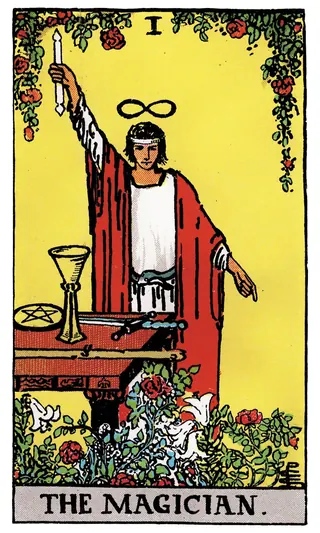
The value you aim to offer
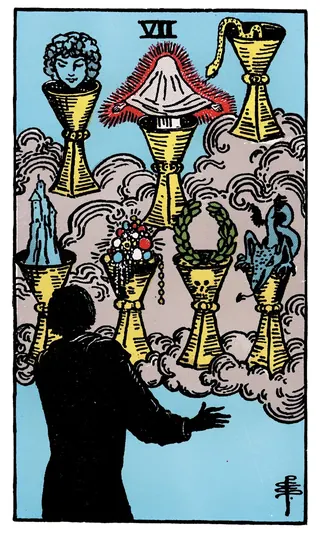
An assumption to test
The next evidence-gathering step
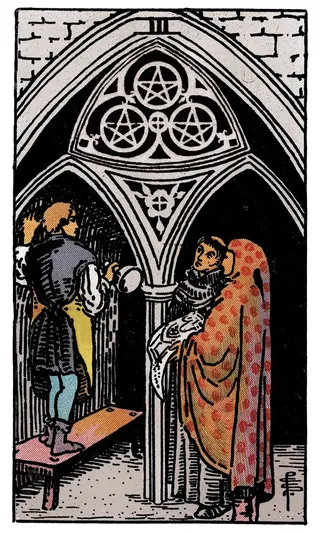
Pamela Colman Smith · Rider–Waite–Smith (1909)
These three upright cards are selected as an instructional example, not presented as a random draw or a recorded personal reading. Your own cards may differ; the method is to connect the symbol, position and context.
1. The value you aim to offer — The Magician
The Magician brings capabilities into focus. Identify what you can actually deliver, rather than assume that enthusiasm is a complete offer.
2. An assumption to test — Seven of Cups
The Seven of Cups evokes options and wishful thinking. Select one assumption about customers that you have not yet tested.
3. The next evidence-gathering step — Three of Pentacles
The Three of Pentacles suggests feedback and collaboration. A small trial with real users can produce information a draw cannot provide.
Put the example together
Connect the value you aim to offer with an assumption to test, then use the next evidence-gathering step to identify something you can examine or do. Look for a shared theme and a tension between the cards. If a connection does not fit what you know, do not force it.
Try an alternative interpretation as well. A card about holding on could describe useful stability or fear of change; decide which fits the evidence rather than selecting the version you prefer.
How to read a reversal here
A reversed card uses the reversed keywords shown in your result. Read those themes through the same position. It does not automatically negate the upright card or turn the whole spread into a no. A theme of hesitation, for example, can prompt a question about your own uncertainty without identifying another person’s motive.
Learn more about reversed tarot cards. Use the full card meaning as context, not as a substitute for the facts of your situation.
Cards traditionally read as good signs for a business
When readers look at a business question, the Pentacles suit carries the most weight, since it governs money, work and material results. These ten cards are among the most welcome.
| Card | Why it is read as encouraging for a venture |
|---|---|
| Ace of Pentacles | a seed of real opportunity: a first client, funding or a promising idea with substance. |
| Three of Pentacles | skilled collaboration and good feedback from people who know the craft. |
| Eight of Pentacles | steady, careful work that builds quality one order at a time. |
| Nine of Pentacles | independence earned through effort, often read as a self-sustaining business. |
| Ten of Pentacles | lasting wealth and something built to outlive its first year. |
| Three of Wands | expansion and new markets on the horizon. |
| Six of Wands | recognition, good reviews and public momentum. |
| King of Pentacles | sound management and a practical head for money. |
| The Emperor | structure, systems and leadership that hold things together. |
| The Chariot | drive and focus that push through obstacles. |
Encouraging cards describe strengths you can lean on. They do not replace a budget, a customer list or a cash forecast.
Cards that signal caution for your business
These cards are traditionally read as warnings rather than failure. In a business reading, they point to pressure points worth fixing early.
- Five of Pentacles: cash strain or feeling left out of opportunities; check your runway.
- Seven of Cups: too many ideas at once; pick one offer and test it.
- Ten of Wands: overwork and burnout from carrying everything alone.
- Five of Wands: crowded competition, or internal conflict among partners.
- Four of Pentacles: holding on so tightly that growth stalls.
- Two of Pentacles: juggling bills and priorities; cash flow needs attention.
- Nine of Wands: exhaustion and defensiveness after repeated setbacks.
- The Tower: a sudden shake-up in the market, a supplier or a plan.
- The Fool: a leap without a net, read here as risk taken before the homework is done.
A warning card is valuable precisely because it highlights the area to review first, whether that is spending, workload or focus.
Reading a mixed spread about your business
Business spreads rarely come out all good or all bad. Picture Ace of Pentacles, Five of Wands and Seven of Pentacles.
The Ace of Pentacles suggests a genuine opportunity: something people may actually pay for. The Five of Wands brings a scene of crossed sticks and many hands, which readers link to a crowded field or a lot of noise from competitors. The Seven of Pentacles shows a worker pausing to assess a crop that is not yet ready, a traditional image of slow growth and the need to evaluate before investing more.
Together, these cards tell a story many founders will recognize: the idea has merit, the market is busy, and returns will take longer than hoped. The practical response is to differentiate, measure what is working and give the venture a defined test period. In any mixed business draw, treat the most cautious card as your to-do list rather than your forecast.
How long until a business succeeds?
Tarot timing is symbolic. One convention reads Wands as days or weeks, Swords as weeks, Cups as months and Pentacles as months to years; readers differ, so this is tradition rather than a business plan. The Seven of Pentacles is the card most associated with waiting for an investment to mature.
Real-world numbers are more useful here. U.S. Bureau of Labor Statistics survival data show that of private-sector establishments that opened in the year ending March 2019, about 79% were still operating one year later and about 51% after five years. In other words, many survive, and many do not, which is why the early years deserve careful tracking.
Instead of waiting for a card to name a date, set milestones you can measure: a first paying customer, a month that covers costs, a repeat order rate. Those markers tell you whether the business is on track far sooner than any reading.
What to do after asking if your business will succeed
- Write a one-line definition of success with a number and a date, such as revenue, customers or break-even.
- Talk to five potential customers this week and listen for what they would pay for.
- Calculate your cash runway: how many months you can operate at current spending.
- Book a free session with a SCORE volunteer mentor; the organization says its mentoring stays free for the life of your business.
- Check legal and tax basics with an accountant or attorney before signing leases or loans.
Draw on this question once at the start of a phase and again only after a real milestone, not every time sales dip. Related readings include will my finances improve and should I change careers. If money stress is affecting your health or relationships, a financial counselor or therapist is a better next call than the deck.
Real signs your business is on track
Some signals matter more than any card you could draw for this question, and they are worth checking every month.
- Customers come back. Repeat purchases show the offer solves a real problem, not just a curiosity.
- Referrals arrive unprompted. When people recommend you without being asked, word of mouth is doing your marketing.
- Margins hold. Each sale should leave money after direct costs; growth that loses money on every order is a warning.
- Cash in arrives before cash out runs dry. Profitable businesses still fail when invoices are paid too late.
- You can rest. If the venture collapses whenever you take a day off, it needs systems or help.
If most of these are improving, the business is moving in the right direction, whatever the spread shows. If they are not, adjust the offer, pricing or costs before investing more.
Practical checks after this reading
- Define success using a concrete time frame and measure.
- Identify one assumption unsupported by customer evidence.
- Run a proportionate test and review what it actually shows.
Record the cards, one possible interpretation and one fact that would help you evaluate it. If the draw does not fit, leave it aside. Repeating a draw until it feels reassuring does not make the result more informative.
Choose the question you actually mean
These related spreads examine different questions; one answer should not be used to settle the others.
More tarot readings by question
Love and attraction
- Does he like me?
- Does she like me?
- How does he feel about me?
- Is he thinking about me?
- Does he miss me?
- Will he text me?
- Should I text him?
- Is he the one?
- Will he commit?
- Will I find love?
- When will I meet my soulmate?
- Future husband tarot
- Will I get married?
Exes and second chances
- Will he come back?
- Will she come back?
- Does my ex still love me?
- Will my ex contact me?
- Will we get back together?
- Should I forgive him?
- Should I stay or leave?
Work, money and study
- Will I get the job?
- Will I get promoted?
- Should I quit my job?
- Should I change careers?
- Will my finances improve?
- Will I pass my exam?
Life decisions
Frequently asked questions
Can this reading answer “Will my business succeed?” with certainty?
Business success needs a definition before it can be assessed. This spread helps you examine the value you aim to provide, an assumption that needs evidence and a practical test. It does not predict sales, profit or the survival of a business.
How is this spread different from the other readings?
This spread uses the value you aim to offer, an assumption to test and the next evidence-gathering step. Its worked example and practical checks focus on this question. It does not use a generic yes/no score.
Does typing my question change the interpretation?
No. The optional note is for your own context. Cards are drawn at random in your browser, and the prompts are written for the positions on this page. No AI analyses your note in this tool.
What should I do with an unclear or uncomfortable reading?
Record one possible interpretation and compare it with what you know. If it does not fit, you can leave it aside. Another draw cannot establish a missing fact; use a conversation, records or other relevant information instead.
Method and further reading
This tool uses the site’s Rider–Waite–Smith card keywords with question-specific reflection prompts. It does not analyse your optional note with AI, infer hidden information or calculate the likelihood of an outcome. The worked example explains how to apply the positions.
Learn to read a complete tarot spread · All 78 card meanings · How our tools work
Sources cited on this page:
- Table 7. Survival of private sector establishments by opening year · U.S. Bureau of Labor Statistics
- SCORE: Free Small Business Mentoring · SCORE