A wish becomes easier to work with when you define the outcome and what influences it. This spread separates the wish, the part outside your control and an action within your control. It cannot promise fulfilment or turn coincidence into evidence.
For reflection and entertainment. Tarot and AI readings don't predict the future and aren't financial, medical, legal or psychological advice. Use them as a prompt to think, not as a decision.
Will my wish come true? Draw your three cards
Free, no signup. Three distinct cards are drawn at random from the full 78-card deck. Each has a one-in-three chance of appearing reversed.
This random draw does not establish an outcome, reveal another person’s private thoughts or give a date. Use it as a prompt; check facts separately.
The three positions for this question
Set these positions before drawing. Read each card through its position instead of applying the same meaning to all three.
1. The wish you actually mean
Use this symbol to turn the wish into a clear outcome. What would count as fulfilment, and what underlying need does it serve?
2. What lies outside your control
Read the card as a prompt about other people's choices or external conditions. Which parts cannot be resolved by your effort or a draw?
3. An action within your control
Use the symbol to identify a proportionate step. What could you do that serves the underlying need even without the exact wished-for result?
Keep this question in focus
Some wishes depend on another person's decision or on circumstances you cannot direct. Make room for that uncertainty. The reading is most useful when it reveals an assumption you can check or a step worth taking even if the final outcome changes.
A complete example for “Will my wish come true?”
The wish you actually mean
What lies outside your control
An action within your control
Pamela Colman Smith · Rider–Waite–Smith (1909)
These three upright cards are selected as an instructional example, not presented as a random draw or a recorded personal reading. Your own cards may differ; the method is to connect the symbol, position and context.
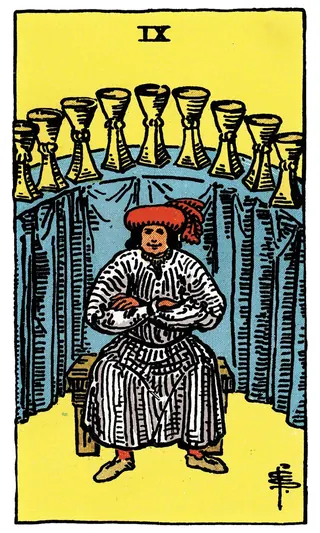
1. The wish you actually mean — Nine of Cups
The Nine of Cups can symbolise satisfaction. In the first position, ask what you hope the wish would let you feel.
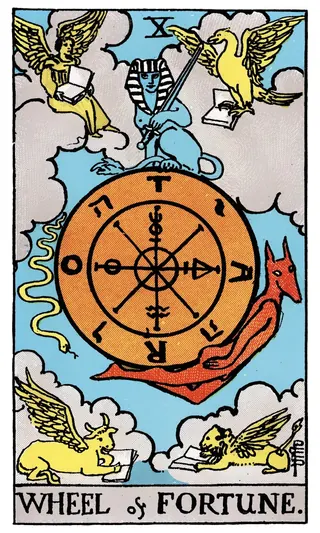
2. What lies outside your control — Wheel of Fortune
Wheel of Fortune highlights change and uncertainty. It is a reminder to leave room for circumstances, not a guarantee that luck will deliver the wish.
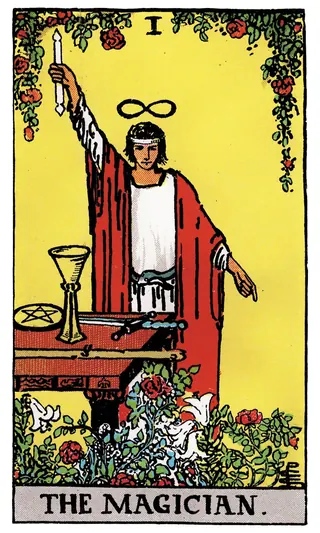
3. An action within your control — The Magician
The Magician brings your available skills into focus. Choose an action that genuinely affects the situation rather than waiting for a sign.
Put the example together
Connect the wish you actually mean with what lies outside your control, then use an action within your control to identify something you can examine or do. Look for a shared theme and a tension between the cards. If a connection does not fit what you know, do not force it.
Try an alternative interpretation as well. A card about holding on could describe useful stability or fear of change; decide which fits the evidence rather than selecting the version you prefer.
How to read a reversal here
A reversed card uses the reversed keywords shown in your result. Read those themes through the same position. It does not automatically negate the upright card or turn the whole spread into a no. A theme of hesitation, for example, can prompt a question about your own uncertainty without identifying another person’s motive.
Learn more about reversed tarot cards. Use the full card meaning as context, not as a substitute for the facts of your situation.
The wish card and other hopeful signs
The Nine of Cups is nicknamed the wish card: the figure sits contentedly before a row of full cups, and many readers treat it as the strongest yes for this question. These other cards are also traditionally read as favorable for a wish:
- The Star: Hope renewed and a sense that the universe is on your side.
- Ten of Cups: Emotional fulfillment, especially for wishes about family or love.
- The World: Completion; the goal reached and the circle closed.
- The Sun: Success, clarity and happiness in plain sight.
- Ace of Wands: The spark of a new venture; energy to begin.
- Ace of Pentacles: A tangible opportunity, such as money, a home or a practical gift.
- Six of Wands: Achievement that others recognize.
- The Empress: Growth and abundance; wishes that need nurturing over time.
- Three of Wands: Plans in motion and results beginning to come back.
Even the Nine of Cups asks a quiet question: is this wish about real satisfaction, or about how it will look? Readers often see it as a nudge to want what genuinely feeds you.
Cards that ask you to wait or rethink
A difficult card does not curse your wish. Readers usually interpret these as signs that the wish needs reshaping, patience or a different route.
- Seven of Cups: Too many dreams at once; choose one and make it concrete.
- Five of Cups: Focusing on what failed; what still stands behind you?
- Four of Cups: Missing an offer that is already here because it does not look like the wish.
- The Tower: Sudden change that may break the plan but clear ground for a better one.
- Eight of Swords: Believing there is no way forward when more options exist.
- Ten of Swords: An ending; this version of the wish may be finished.
- The Moon: Unclear facts; something about the situation is not what it seems.
- Five of Pentacles: Scarcity and hardship; look for help rather than waiting alone.
- Seven of Pentacles: Slow growth; the effort is planted but the harvest is not ready.
If your spread is heavy with these, ask what wish sits underneath the one you named. Sometimes the deeper need can be met another way.
Reading a hopeful card next to a hard one
Picture a draw of Nine of Cups, Seven of Cups and Knight of Pentacles. The wish card appears, but beside the card of daydreams, followed by the slowest knight in the deck.
One reading: the wish could genuinely satisfy you (Nine of Cups), yet it is currently scattered among several fantasies, or described too vaguely to act on (Seven of Cups). The Knight of Pentacles answers with steady, unglamorous effort, done in the same direction week after week.
So the spread is neither yes nor no. It says the wish is worth having, it needs sharper definition, and it will most likely be reached slowly rather than by luck. When a happy card sits beside a cautionary one, treat the happy card as the destination and the hard card as the work. If you want a quick single-card temperature check afterward, the yes or no tarot draw can help, but keep it to one.
When will my wish come true?
There is no reliable tarot calendar for wishes. Readers pass down conventions such as Wands meaning days or weeks, Cups weeks to months, Swords swift change, and Pentacles months or more, with Pages read as early stages and Kings as maturity. Treat these as storytelling tools, not schedules.
Wheel of Fortune in a timing position is often read as a cycle turning, and Temperance as gradual blending over time; both describe a rhythm, not a date.
A more dependable clock is the one built into the wish itself. A job application has a decision date. A savings goal has a monthly amount. A wish about another person depends on their choices and has no deadline you can set. Sort your wish into one of those types, then watch the real milestones that belong to it instead of waiting for a card to announce the moment.
What to do after a wish reading
Motivation research suggests that dreaming alone is not enough. Psychologist Gabriele Oettingen's WOOP method (Wish, Outcome, Obstacle, Plan) pairs a wish with the inner obstacle most likely to block it. You can use it right after your reading:
- Wish: write it in one specific sentence.
- Outcome: picture the best result and how it would feel.
- Obstacle: name the habit, fear or emotion inside you most likely to get in the way.
- Plan: write an if-then line, such as: if I start scrolling at night, then I will spend ten minutes on the application.
Then stop asking the cards about this wish for a while, perhaps a month, and let your actions produce new information. If the wish involves health, money or legal matters, check with a qualified professional. If longing for it is making you miserable, a counselor or a trusted friend can help. Related: what should I do.
Signs a wish is actually moving
Wishes rarely arrive all at once. Progress tends to show up in smaller, checkable ways:
- A door opens a little: a reply, an interview, a callback, a first sale.
- You find the next step is clearer than it was a month ago.
- People who can help start to know what you want.
- Your obstacles change from vague worry into specific problems you can solve.
It is also worth noticing when a wish has quietly changed. Sometimes the original goal fades because something better has taken its place, or because you met the underlying need another way. That is not failure. Write the date and the wish in a notebook, then reread it after a season to see what actually shifted. A reading is most valuable when it helps you notice which wish still matters and which one you are ready to release.
Practical checks after this reading
- Define the wish as a specific outcome.
- Separate your choices from external decisions.
- Choose a useful step and an alternative way to meet the underlying need.
Record the cards, one possible interpretation and one fact that would help you evaluate it. If the draw does not fit, leave it aside. Repeating a draw until it feels reassuring does not make the result more informative.
Choose the question you actually mean
These related spreads examine different questions; one answer should not be used to settle the others.
More tarot readings by question
Love and attraction
- Does he like me?
- Does she like me?
- How does he feel about me?
- Is he thinking about me?
- Does he miss me?
- Will he text me?
- Should I text him?
- Is he the one?
- Will he commit?
- Will I find love?
- When will I meet my soulmate?
- Future husband tarot
- Will I get married?
Exes and second chances
- Will he come back?
- Will she come back?
- Does my ex still love me?
- Will my ex contact me?
- Will we get back together?
- Should I forgive him?
- Should I stay or leave?
Work, money and study
- Will I get the job?
- Will I get promoted?
- Should I quit my job?
- Should I change careers?
- Will my business succeed?
- Will my finances improve?
- Will I pass my exam?
Life decisions
Frequently asked questions
Can this reading answer “Will my wish come true?” with certainty?
A wish becomes easier to work with when you define the outcome and what influences it. This spread separates the wish, the part outside your control and an action within your control. It cannot promise fulfilment or turn coincidence into evidence.
How is this spread different from the other readings?
This spread uses the wish you actually mean, what lies outside your control and an action within your control. Its worked example and practical checks focus on this question. It does not use a generic yes/no score.
Does typing my question change the interpretation?
No. The optional note is for your own context. Cards are drawn at random in your browser, and the prompts are written for the positions on this page. No AI analyses your note in this tool.
What should I do with an unclear or uncomfortable reading?
Record one possible interpretation and compare it with what you know. If it does not fit, you can leave it aside. Another draw cannot establish a missing fact; use a conversation, records or other relevant information instead.
Method and further reading
This tool uses the site’s Rider–Waite–Smith card keywords with question-specific reflection prompts. It does not analyse your optional note with AI, infer hidden information or calculate the likelihood of an outcome. The worked example explains how to apply the positions.
Learn to read a complete tarot spread · All 78 card meanings · How our tools work
Sources cited on this page:
- WOOP my life · WOOP (Gabriele Oettingen)