Wondering about his feelings often means the conversation has not made them clear. This spread helps you separate the story you are telling yourself from his observable behaviour and prepare a conversation that can provide real information.
For reflection and entertainment. Tarot and AI readings don't predict the future and aren't financial, medical, legal or psychological advice. Use them as a prompt to think, not as a decision.
How does he feel about me? Draw your three cards
Free, no signup. Three distinct cards are drawn at random from the full 78-card deck. Each has a one-in-three chance of appearing reversed.
This random draw does not establish an outcome, reveal another person’s private thoughts or give a date. Use it as a prompt; check facts separately.
The three positions for this question
Set these positions before drawing. Read each card through its position instead of applying the same meaning to all three.
1. The story you are telling
Connect the symbol to your interpretation of his feelings. Which parts are hopes, fears or memories rather than things he has told you?
2. What his behaviour shows
Use the card to examine patterns in observable behaviour without declaring a motive. Is there consistent time, care and follow-through?
3. What to ask directly
Turn the symbol into one respectful, specific question. What would you need to ask to reduce uncertainty without pressuring him to give a preferred answer?
Keep this question in focus
Attraction, affection, comfort and commitment are not interchangeable. Ask what kind of feeling matters to you and what you need to know to make your next choice. A reading cannot supply words he has not said or explain his private motives.
A complete example for “How does he feel about me?”
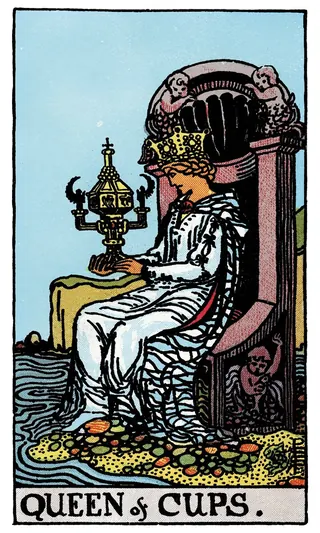
The story you are telling
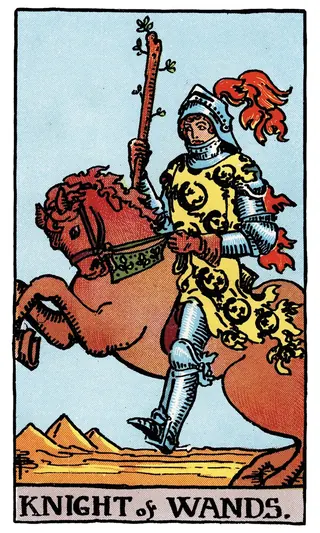
What his behaviour shows
What to ask directly
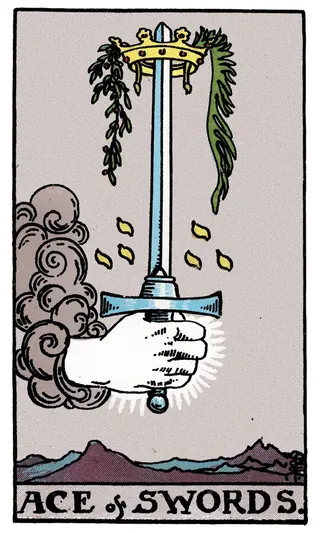
Pamela Colman Smith · Rider–Waite–Smith (1909)
These three upright cards are selected as an instructional example, not presented as a random draw or a recorded personal reading. Your own cards may differ; the method is to connect the symbol, position and context.
1. The story you are telling — Queen of Cups
The Queen of Cups may describe your emotional investment. It encourages you to recognise your feelings rather than project them onto his.
2. What his behaviour shows — Knight of Wands
The Knight of Wands can prompt you to examine intensity versus consistency. Excitement in a meeting does not establish an ongoing intention.
3. What to ask directly — Ace of Swords
The Ace of Swords suggests clear language. Asking how he sees the relationship offers more reliable information than treating the spread as his confession.
Put the example together
Connect the story you are telling with what his behaviour shows, then use what to ask directly to identify something you can examine or do. Look for a shared theme and a tension between the cards. If a connection does not fit what you know, do not force it.
Try an alternative interpretation as well. A card about holding on could describe useful stability or fear of change; decide which fits the evidence rather than selecting the version you prefer.
How to read a reversal here
A reversed card uses the reversed keywords shown in your result. Read those themes through the same position. It does not automatically negate the upright card or turn the whole spread into a no. A theme of hesitation, for example, can prompt a question about your own uncertainty without identifying another person’s motive.
Learn more about reversed tarot cards. Use the full card meaning as context, not as a substitute for the facts of your situation.
Cards traditionally read as warm feelings toward you
When the question is his feelings, readers usually look for cards about care, attraction and steady interest. Treat each one as a theme to hold up against how he actually treats you, not as a transcript of his heart.
- Two of Cups: mutual attraction and the sense of meeting halfway; the classic card of a feeling that is returned.
- Ace of Cups: fresh, open-hearted affection, often read as a feeling that is new or newly expressed.
- The Lovers: strong attraction paired with a choice, asking whether the pull is backed by values you share.
- Knight of Cups: a romantic, approaching energy: someone who wants to show interest, sometimes with a grand gesture.
- Page of Cups: shy curiosity or tender interest that may come across as awkward rather than bold.
- King of Cups: calm, mature care; feelings held steadily rather than announced loudly.
- Six of Cups: fondness, comfort and an easy familiarity, as if he feels at home with you.
- The Sun: open warmth and plain enjoyment of your company, with little he feels the need to hide.
- Four of Wands: feeling relaxed and celebrated around each other, the mood of a good weekend together.
Even a hand full of these cards describes a mood, not a decision. The follow-through you can see over several weeks is what turns a warm card into a fact.
Cards that point to distance, confusion or mixed signals
Some cards are traditionally read as a cooler or more guarded emotional picture. They do not mean you are unlovable or that he dislikes you; often they describe his own preoccupations, poor timing or a connection that needs a frank talk.
- Four of Cups: disinterest or emotional withdrawal, with attention pointed elsewhere for reasons that may have nothing to do with you.
- Eight of Cups: quietly stepping back from something that no longer feels fulfilling to him.
- Five of Cups: regret or grief over the past that leaves little room for a new feeling.
- Knight of Swords: fast, blunt thinking that can outrun tenderness and come across as cold.
- Seven of Swords: something kept private; read it as a cue to check facts gently, never as proof to accuse him.
- The Moon: uncertainty and projection on both sides, where each of you may be guessing.
- Two of Swords: an emotional stalemate in which he avoids naming what he feels.
- The Hermit: a need for space and inward focus that can look like indifference from outside.
- King of Swords: feelings filtered through logic and reserve, so warmth is harder to read.
If several of these land together, take them as a reason to slow down and protect your energy, not as a reason to shuffle again.
Reading a draw that says yes and no at once
Mixed spreads are the norm for this question, because real feelings are rarely one-note. Say you draw the Page of Cups, The Moon and the Nine of Pentacles.
- The story you are telling: Page of Cups. Hopeful, tender interest, and it may be yours as much as his. Notice how much of the picture is daydream.
- What his behavior shows: The Moon. His signals are inconsistent, and you are filling the gaps with guesses. That is information in itself.
- What to ask directly: Nine of Pentacles. Ask from a place of self-respect, with your own life full, so his answer informs you without defining your worth.
Rather than averaging the three cards into a verdict, name the tension: hope versus ambiguity. The useful follow-up is not another spread but a short list of the clear behaviors you would need to see, plus how long you are willing to wait to see them. If one card feels off, note it and move on; a single card rarely carries the whole reading.
Can the cards say when he will show how he feels?
Tarot does not keep a calendar, and nobody can read a date for another person's emotions off a card. Some readers still use timing conventions, and it helps to know them as tradition rather than fact:
- Wands (fire) are linked to days or a few weeks, and the Eight of Wands is often read as "soon."
- Swords (air) are linked to weeks.
- Cups (water) are linked to weeks or months.
- Pentacles (earth) are linked to months or longer.
Other readers map suits to seasons instead, so the systems contradict each other. A more honest clock is his behavior over the next month: does he start conversations and plans, follow up after you see each other, include you around friends, and keep his word on small things? Consistency across a few weeks tells you more about his feelings than any timing card. If you notice you are counting days, that is your cue to shift attention back to your own plans.
What to do after a reading about his feelings
- Write down what he has actually said and done in the last month, kept separate from what you think it means.
- Decide what you want: a date, exclusivity or simply clarity. His feelings only matter in relation to that.
- Ask one light, honest question, such as "I enjoy spending time with you. How are you seeing this?"
- Take his answer at face value, even when it is not the one you hoped for.
- Keep your own routines, friends and goals going while you wait.
Stop consulting the cards about him when you are drawing mainly to calm anxiety, when you have asked the same thing more than once this week, or when he has already told you where he stands. If rumination about him keeps you up at night or starts to dent your self-esteem, talk it over with a trusted friend, and consider a counselor if it lasts. To talk the situation through without pressure, the love psychic chat is there for reflection, not guarantees, and the does he like me reading suits earlier-stage crushes.
Practical checks after this reading
- Name whether you need clarity about attraction or commitment.
- Write two observable behaviours without adding a motive.
- Ask one direct question and leave room for an honest answer.
Record the cards, one possible interpretation and one fact that would help you evaluate it. If the draw does not fit, leave it aside. Repeating a draw until it feels reassuring does not make the result more informative.
Choose the question you actually mean
These related spreads examine different questions; one answer should not be used to settle the others.
More tarot readings by question
Love and attraction
- Does he like me?
- Does she like me?
- Is he thinking about me?
- Does he miss me?
- Will he text me?
- Should I text him?
- Is he the one?
- Will he commit?
- Will I find love?
- When will I meet my soulmate?
- Future husband tarot
- Will I get married?
Exes and second chances
- Will he come back?
- Will she come back?
- Does my ex still love me?
- Will my ex contact me?
- Will we get back together?
- Should I forgive him?
- Should I stay or leave?
Work, money and study
- Will I get the job?
- Will I get promoted?
- Should I quit my job?
- Should I change careers?
- Will my business succeed?
- Will my finances improve?
- Will I pass my exam?
Life decisions
Frequently asked questions
Can this reading answer “How does he feel about me?” with certainty?
Wondering about his feelings often means the conversation has not made them clear. This spread helps you separate the story you are telling yourself from his observable behaviour and prepare a conversation that can provide real information.
How is this spread different from the other readings?
This spread uses the story you are telling, what his behaviour shows and what to ask directly. Its worked example and practical checks focus on this question. It does not use a generic yes/no score.
Does typing my question change the interpretation?
No. The optional note is for your own context. Cards are drawn at random in your browser, and the prompts are written for the positions on this page. No AI analyses your note in this tool.
What should I do with an unclear or uncomfortable reading?
Record one possible interpretation and compare it with what you know. If it does not fit, you can leave it aside. Another draw cannot establish a missing fact; use a conversation, records or other relevant information instead.
Method and further reading
This tool uses the site’s Rider–Waite–Smith card keywords with question-specific reflection prompts. It does not analyse your optional note with AI, infer hidden information or calculate the likelihood of an outcome. The worked example explains how to apply the positions.
Learn to read a complete tarot spread · All 78 card meanings · How our tools work