When someone is quiet, it is easy to look for signs that you remain on his mind. This spread focuses on the attention you are giving the question, the evidence you have and where to place your own attention next. It cannot read his thoughts.
For reflection and entertainment. Tarot and AI readings don't predict the future and aren't financial, medical, legal or psychological advice. Use them as a prompt to think, not as a decision.
Is he thinking about me? Draw your three cards
Free, no signup. Three distinct cards are drawn at random from the full 78-card deck. Each has a one-in-three chance of appearing reversed.
This random draw does not establish an outcome, reveal another person’s private thoughts or give a date. Use it as a prompt; check facts separately.
The three positions for this question
Set these positions before drawing. Read each card through its position instead of applying the same meaning to all three.
1. Why this question returns
Use the card to explore when you start wondering about his thoughts. What feeling or trigger tends to come just before the question?
2. Signals and alternative explanations
Connect the symbol to a sign you have noticed, then write a second plausible explanation. What would direct evidence look like instead?
3. Where to put your attention
Use the card to choose one activity or conversation you control. What would be worthwhile even if you never learn what he was thinking?
Keep this question in focus
A thought, even if he told you about it, would not necessarily imply love, contact or commitment. Avoid treating coincidences as messages from him. The practical value of this reading is recognising what the question is doing to your own attention.
A complete example for “Is he thinking about me?”
Why this question returns
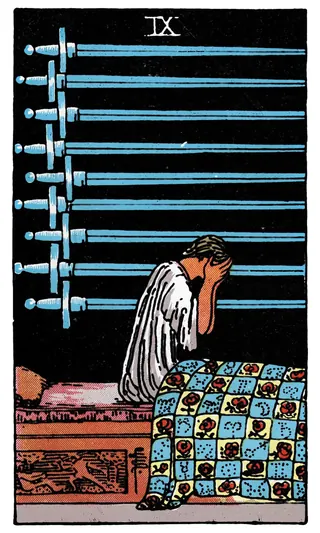
Signals and alternative explanations
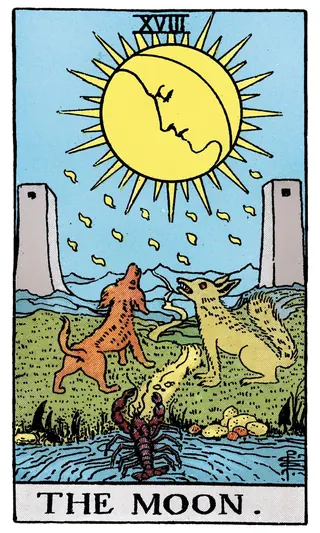
Where to put your attention
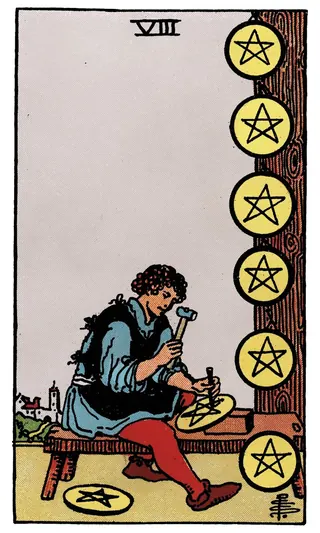
Pamela Colman Smith · Rider–Waite–Smith (1909)
These three upright cards are selected as an instructional example, not presented as a random draw or a recorded personal reading. Your own cards may differ; the method is to connect the symbol, position and context.
1. Why this question returns — Nine of Swords
The Nine of Swords can describe worry. In the first position, it directs attention to your repeated question rather than diagnosing what is happening in his mind.
2. Signals and alternative explanations — The Moon
The Moon represents an unclear picture. A coincidence can become a prompt for your own reflection without being evidence of telepathy or a message.
3. Where to put your attention — Eight of Pentacles
The Eight of Pentacles suggests focused practice. A short, absorbing task can be a useful way to return attention to your own day.
Put the example together
Connect why this question returns with signals and alternative explanations, then use where to put your attention to identify something you can examine or do. Look for a shared theme and a tension between the cards. If a connection does not fit what you know, do not force it.
Try an alternative interpretation as well. A card about holding on could describe useful stability or fear of change; decide which fits the evidence rather than selecting the version you prefer.
How to read a reversal here
A reversed card uses the reversed keywords shown in your result. Read those themes through the same position. It does not automatically negate the upright card or turn the whole spread into a no. A theme of hesitation, for example, can prompt a question about your own uncertainty without identifying another person’s motive.
Learn more about reversed tarot cards. Use the full card meaning as context, not as a substitute for the facts of your situation.
Cards traditionally read as “you are on his mind”
In a spread about his thoughts, these cards are usually read as signs that you hold some space in his attention. Thinking about someone, though, is cheap and frequent; it says little about what he will do.
- Page of Cups: a passing romantic thought or a message he drafts in his head.
- Knight of Cups: daydreaming about you, sometimes with a plan to act on it.
- Ace of Cups: a fresh wave of feeling that keeps returning to the same person.
- The Lovers: you feature in a choice he is turning over.
- Two of Cups: thoughts of you that include the idea of a shared future.
- Six of Cups: remembering moments you spent together, often fondly.
- The Magician: focused attention; he may be thinking about how to approach you.
- Nine of Cups: satisfaction when you come to mind, a pleasant association.
- Ace of Swords: a clear thought or decision about you is forming.
- Page of Swords: curiosity; he may be watching from a distance and gathering information.
Cards read as “his mind is elsewhere”
These cards are not insults. For this question they usually say his attention is taken up by something else, which is common and not personal.
- Four of Cups: boredom or disinterest; his focus is turned inward.
- Eight of Pentacles: absorbed in work or a project, with little room for romance right now.
- Ten of Wands: overloaded and stressed, so personal thoughts get pushed aside.
- The Hermit: deliberate solitude and introspection about himself.
- Two of Pentacles: juggling many priorities, with you not near the top.
- Seven of Swords: thoughts he keeps hidden, or attention given to someone else.
- Queen of Swords: a cool, analytical view of the situation rather than a warm one.
- Nine of Swords: worry, but often about his own life rather than about you.
- Death: a closed door in his thinking; he may have mentally ended this chapter.
If several of these appear, consider whether the more useful question is about your own attention: what would you be doing right now if you were not wondering about him?
Reading a confusing spread about his thoughts
Say you draw the Knight of Cups, the Eight of Pentacles and the Seven of Swords. At first glance it looks like interest, then busyness, then secrecy.
One grounded way to read it: the Knight of Cups shows that a romantic impulse exists, the Eight of Pentacles shows that daily obligations are crowding it out, and the Seven of Swords suggests something is not being said, possibly by him, possibly by you. Notice that the spread does not settle whether you are on his mind; it describes competing priorities.
The Seven of Swords is the most important card here. Before deciding it means he is hiding something, ask whether you are hiding something too, such as how much time you spend thinking about him or a question you have not asked out loud.
If the result still feels unclear, write down two plausible readings and wait a few days. Clarity usually comes from what happens, not from a second spread drawn on the same evening.
Does tarot show when he will think of me or reach out?
Thoughts happen constantly and leave no record, so this is the hardest question of all to time. Tarot traditions offer symbolic shortcuts that some readers find useful as prompts:
- Aces point to a beginning, read as “soon” only in a loose sense.
- Court cards are often read as people, not dates, so they rarely answer “when.”
- The Wheel of Fortune suggests a turn in circumstances on its own schedule.
- The Seven of Pentacles asks for patience and a long view.
Seasonal systems that match suits to spring, summer, fall and winter exist, but readers disagree on which suit belongs where. Treat any timing as a mood, not a forecast.
In real life, the only timing that counts is behavior: a message, an invitation or a conversation. A thought he never voices does not change your day, which is why tracking his possible thoughts tends to cost more than it gives.
After the reading: getting your attention back
- Note the moment the question appeared today. Boredom, a song or a lonely evening are common triggers.
- Write one fact you actually know about his feelings, and one guess. Keep them in separate columns.
- Choose an activity with an ending, like a walk, a recipe or a chapter of a book, instead of scrolling.
- If you want to know what he thinks, consider whether asking him directly is possible and appropriate.
- Use a broader spread such as how does he feel about me only once, not as a nightly ritual.
A good rule is to stop drawing for this question once you notice you are looking for a specific card. At that point the deck is serving the worry, not the reflection.
If thinking about him crowds out sleep, work or friendships for weeks, a counselor can help you understand why the loop is so sticky. A trusted friend is also a better sounding board than another draw.
Why signs feel convincing, and what counts instead
When you are waiting on one person, your mind starts to notice anything connected to him: his name on a license plate, his favorite band on the radio, a dream about him. Psychologists call the tendency to favor information that fits what we already believe confirmation bias, and it explains why coincidences can feel like messages.
Things that do tell you something about his thoughts:
- He starts conversations, not only replies.
- He remembers details you told him and brings them up.
- He makes time for you when it is inconvenient.
- He asks questions about your life and listens to the answers.
A useful test is to imagine the same sign coming from someone you do not care about. If you would shrug it off, it is probably not evidence.
If none of those are happening, the kindest reading of any card, even The Sun, is that your energy deserves somewhere it is returned.
Practical checks after this reading
- Notice the trigger before you start checking for signs.
- Give each supposed signal at least one ordinary alternative explanation.
- Choose a task with a clear stopping point instead of another search.
Record the cards, one possible interpretation and one fact that would help you evaluate it. If the draw does not fit, leave it aside. Repeating a draw until it feels reassuring does not make the result more informative.
Choose the question you actually mean
These related spreads examine different questions; one answer should not be used to settle the others.
More tarot readings by question
Love and attraction
- Does he like me?
- Does she like me?
- How does he feel about me?
- Does he miss me?
- Will he text me?
- Should I text him?
- Is he the one?
- Will he commit?
- Will I find love?
- When will I meet my soulmate?
- Future husband tarot
- Will I get married?
Exes and second chances
- Will he come back?
- Will she come back?
- Does my ex still love me?
- Will my ex contact me?
- Will we get back together?
- Should I forgive him?
- Should I stay or leave?
Work, money and study
- Will I get the job?
- Will I get promoted?
- Should I quit my job?
- Should I change careers?
- Will my business succeed?
- Will my finances improve?
- Will I pass my exam?
Life decisions
Frequently asked questions
Can this reading answer “Is he thinking about me?” with certainty?
When someone is quiet, it is easy to look for signs that you remain on his mind. This spread focuses on the attention you are giving the question, the evidence you have and where to place your own attention next. It cannot read his thoughts.
How is this spread different from the other readings?
This spread uses why this question returns, signals and alternative explanations and where to put your attention. Its worked example and practical checks focus on this question. It does not use a generic yes/no score.
Does typing my question change the interpretation?
No. The optional note is for your own context. Cards are drawn at random in your browser, and the prompts are written for the positions on this page. No AI analyses your note in this tool.
What should I do with an unclear or uncomfortable reading?
Record one possible interpretation and compare it with what you know. If it does not fit, you can leave it aside. Another draw cannot establish a missing fact; use a conversation, records or other relevant information instead.
Method and further reading
This tool uses the site’s Rider–Waite–Smith card keywords with question-specific reflection prompts. It does not analyse your optional note with AI, infer hidden information or calculate the likelihood of an outcome. The worked example explains how to apply the positions.
Learn to read a complete tarot spread · All 78 card meanings · How our tools work
Sources cited on this page:
- Confirmation bias · Encyclopaedia Britannica