Commitment means different things to different people. This spread helps you define the agreement you want, compare it with what he has expressed and decide your own limit on waiting. It cannot promise that he will change his mind.
For reflection and entertainment. Tarot and AI readings don't predict the future and aren't financial, medical, legal or psychological advice. Use them as a prompt to think, not as a decision.
Will he commit? Draw your three cards
Free, no signup. Three distinct cards are drawn at random from the full 78-card deck. Each has a one-in-three chance of appearing reversed.
This random draw does not establish an outcome, reveal another person’s private thoughts or give a date. Use it as a prompt; check facts separately.
The three positions for this question
Set these positions before drawing. Read each card through its position instead of applying the same meaning to all three.
1. The commitment you want
Use this card to define commitment in observable terms. What exactly would change: exclusivity, regular contact, shared plans or another agreement?
2. The agreement currently offered
Read this symbol against what he has actually agreed to. Which promises have follow-through, and which expectations have never been discussed?
3. Your boundary on waiting
Use the symbol to decide what you are willing to accept now. What limit on uncertainty would respect your own needs without becoming an ultimatum?
Keep this question in focus
Exclusivity, reliability, shared plans and marriage are separate agreements. Name the one you mean. Someone can enjoy a connection without wanting the same agreement, and affection does not remove the need for an explicit conversation.
A complete example for “Will he commit?”
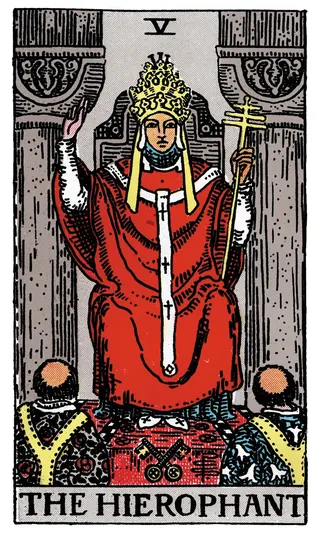
The commitment you want
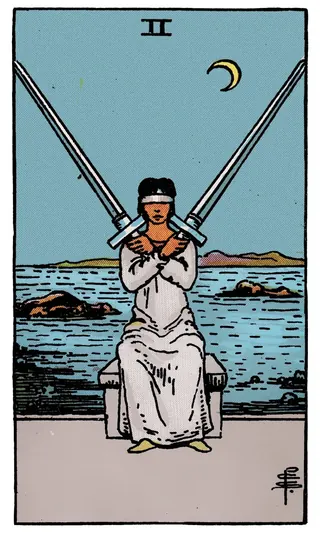
The agreement currently offered
Your boundary on waiting
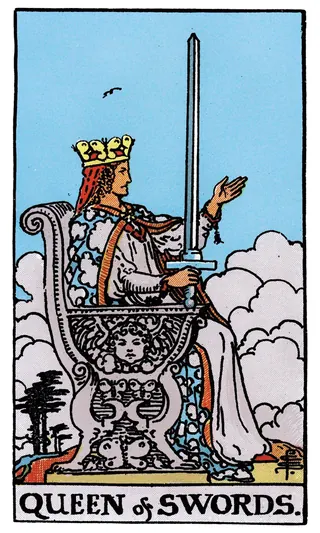
Pamela Colman Smith · Rider–Waite–Smith (1909)
These three upright cards are selected as an instructional example, not presented as a random draw or a recorded personal reading. Your own cards may differ; the method is to connect the symbol, position and context.
1. The commitment you want — The Hierophant
The Hierophant highlights agreements and expectations. It asks what commitment means to you, rather than predicting a proposal.
2. The agreement currently offered — Two of Swords
The Two of Swords can represent an unresolved choice. In this position, look at what has not yet been agreed instead of inventing a hidden obstacle.
3. Your boundary on waiting — Queen of Swords
The Queen of Swords suggests a clear limit. You might explain what relationship you want and decide what you will do if your aims differ.
Put the example together
Connect the commitment you want with the agreement currently offered, then use your boundary on waiting to identify something you can examine or do. Look for a shared theme and a tension between the cards. If a connection does not fit what you know, do not force it.
Try an alternative interpretation as well. A card about holding on could describe useful stability or fear of change; decide which fits the evidence rather than selecting the version you prefer.
How to read a reversal here
A reversed card uses the reversed keywords shown in your result. Read those themes through the same position. It does not automatically negate the upright card or turn the whole spread into a no. A theme of hesitation, for example, can prompt a question about your own uncertainty without identifying another person’s motive.
Learn more about reversed tarot cards. Use the full card meaning as context, not as a substitute for the facts of your situation.
Cards traditionally read as movement toward commitment
When people ask whether he will commit, they usually mean exclusivity, a shared future or marriage. These cards are the ones readers most often associate with that kind of steadiness. Read them as a description of the energy in the relationship, then check it against what he has actually offered.
- Four of Wands: a stable home base and a bond worth celebrating; one of the most commitment-flavored cards in the deck.
- The Hierophant: formal agreements and shared values, sometimes read as engagement or marriage.
- Two of Cups: a mutual pledge between equals, both people choosing the same thing.
- Ten of Cups: a shared picture of home and family life that both partners can see.
- The Emperor: structure and reliability, building something meant to last.
- King of Pentacles: commitment shown through practical support, dependability and long-range planning.
- Knight of Pentacles: slow but steady; he may commit at a careful pace rather than not at all.
- Justice: a fair, explicit agreement in which the terms are said out loud.
- The Lovers: a conscious choice of each other, not just attraction.
- Ace of Cups: a new emotional beginning, sometimes associated with a proposal.
Cards often read as hesitation or a "not now"
The following cards are traditionally read as reluctance, unreadiness or a mismatch in what each person wants. They describe a present pattern, not a permanent verdict, and they say nothing about your worth.
- The Fool: a strong pull toward freedom and keeping options open.
- Seven of Cups: too many possibilities, or an idealized picture that makes choosing hard.
- Page of Wands: enthusiasm that sparks quickly but may not have staying power yet.
- Knight of Wands: passion that moves fast and may move on just as fast.
- Four of Cups: emotional complacency; he may not see a reason to change what already works for him.
- The Devil: a bond held by habit, chemistry or fear instead of a free and open choice.
- Five of Wands: conflicting expectations that have never been sorted out.
- The Hermit: a need for solitude that leaves little room to build a life with someone.
- Eight of Cups: emotional distance or a quiet exit from a deeper connection.
If these show up repeatedly, the kindest reading is usually about you: what you need, and how long you are willing to wait for it.
How to read a mixed commitment draw
Suppose your three positions show the Queen of Pentacles, The Fool and the Knight of Pentacles.
- The commitment you want: Queen of Pentacles. A settled, nurturing home life with practical security. That is a clear and reasonable goal.
- The agreement currently offered: The Fool. Spontaneity and an open-ended present. Fun, but nothing has been promised.
- Your boundary on waiting: Knight of Pentacles. Patience with a defined shape, such as a review date you choose and keep.
This draw is not saying "he never will." It points to a mismatch in pace and in what each of you is building. The constructive move is to say what you want plainly and set your own checkpoint, rather than drawing again in a month to see if The Fool has turned into a King. If the middle card feels unfair to him, ask what evidence supports it; a card cannot override what he has clearly told you.
How long until he commits? Timing in tarot
"When will he commit?" is one of the most common follow-ups, and the honest answer is that a card cannot schedule another person's decision. Readers who do use timing rely on conventions that differ from one teacher to the next. A frequent version links Wands to days or weeks, Swords to weeks, Cups to weeks or months and Pentacles to months or more. Others treat court cards as people rather than time frames, or read the Wheel of Fortune as a turning point without a date.
Real-world markers are far more reliable. Does he talk about plans months ahead? Has he introduced you to family and close friends? When you raise exclusivity or the future, does he engage or change the subject? If, after a frank conversation, he says he does not want the same thing, believe him. Your own review point, chosen in advance, is the only deadline that you actually control.
What to do after asking if he will commit
- Write your definition of commitment in one sentence you could say out loud.
- Choose a calm moment to share it, and ask what he wants rather than why he has not offered more.
- Listen for specifics. "Someday" and "let's see" are answers too.
- Decide in private what you will do if his answer is "not now," before the conversation happens.
- Keep investing in your friendships, work and plans, so waiting does not become your whole life.
A boundary is a statement about your own choices, not a test he has to pass. Stop asking the deck once you have had the real conversation, or if you notice you are drawing every few days in the hope the cards change his mind. If you both want to work on it, a couples counselor can help you talk about the future without circling. If you find yourself waiting in relationship after relationship, an individual therapist can help you look at that pattern. You might also try the is he the one reading or talk it through in the love psychic chat.
Practical checks after this reading
- Define the agreement in plain language.
- Ask what he wants rather than why he has not become what you want.
- Set a personal review point based on your needs, not a predicted date.
Record the cards, one possible interpretation and one fact that would help you evaluate it. If the draw does not fit, leave it aside. Repeating a draw until it feels reassuring does not make the result more informative.
Choose the question you actually mean
These related spreads examine different questions; one answer should not be used to settle the others.
More tarot readings by question
Love and attraction
- Does he like me?
- Does she like me?
- How does he feel about me?
- Is he thinking about me?
- Does he miss me?
- Will he text me?
- Should I text him?
- Is he the one?
- Will I find love?
- When will I meet my soulmate?
- Future husband tarot
- Will I get married?
Exes and second chances
- Will he come back?
- Will she come back?
- Does my ex still love me?
- Will my ex contact me?
- Will we get back together?
- Should I forgive him?
- Should I stay or leave?
Work, money and study
- Will I get the job?
- Will I get promoted?
- Should I quit my job?
- Should I change careers?
- Will my business succeed?
- Will my finances improve?
- Will I pass my exam?
Life decisions
Frequently asked questions
Can this reading answer “Will he commit?” with certainty?
Commitment means different things to different people. This spread helps you define the agreement you want, compare it with what he has expressed and decide your own limit on waiting. It cannot promise that he will change his mind.
How is this spread different from the other readings?
This spread uses the commitment you want, the agreement currently offered and your boundary on waiting. Its worked example and practical checks focus on this question. It does not use a generic yes/no score.
Does typing my question change the interpretation?
No. The optional note is for your own context. Cards are drawn at random in your browser, and the prompts are written for the positions on this page. No AI analyses your note in this tool.
What should I do with an unclear or uncomfortable reading?
Record one possible interpretation and compare it with what you know. If it does not fit, you can leave it aside. Another draw cannot establish a missing fact; use a conversation, records or other relevant information instead.
Method and further reading
This tool uses the site’s Rider–Waite–Smith card keywords with question-specific reflection prompts. It does not analyse your optional note with AI, infer hidden information or calculate the likelihood of an outcome. The worked example explains how to apply the positions.
Learn to read a complete tarot spread · All 78 card meanings · How our tools work