Interest can be hard to distinguish from friendliness, especially when you already hope she likes you. This spread explores what you have noticed, what remains ambiguous and how to invite clearer communication without pressure. It cannot establish her attraction.
For reflection and entertainment. Tarot and AI readings don't predict the future and aren't financial, medical, legal or psychological advice. Use them as a prompt to think, not as a decision.
Does she like me? Draw your three cards
Free, no signup. Three distinct cards are drawn at random from the full 78-card deck. Each has a one-in-three chance of appearing reversed.
This random draw does not establish an outcome, reveal another person’s private thoughts or give a date. Use it as a prompt; check facts separately.
The three positions for this question
Set these positions before drawing. Read each card through its position instead of applying the same meaning to all three.
1. What you have noticed
Use this symbol to name an interaction you observed. Describe what happened before attaching a romantic motive to it.
2. What remains ambiguous
Read the card as a prompt about uncertainty. What other explanation could fit the behaviour, and which details are still missing?
3. A respectful way to ask
Use the symbol to plan a clear, low-pressure invitation. What would let her respond freely, including saying no?
Keep this question in focus
Friendliness is not consent to romance, and an indirect sign is not a commitment. Look for reciprocal interest and respect the answer to an invitation. The reading is useful if it helps you be clearer and considerate, not if it becomes a reason to reinterpret a refusal.
A complete example for “Does she like me?”
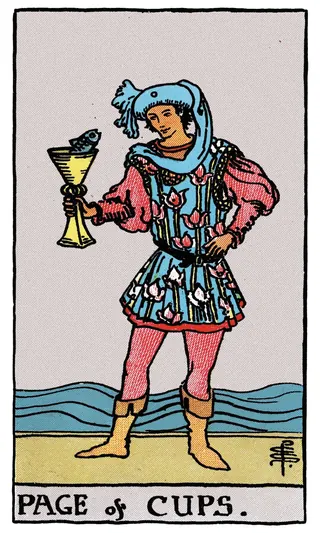
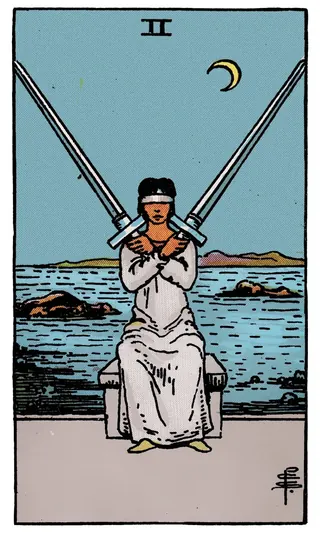
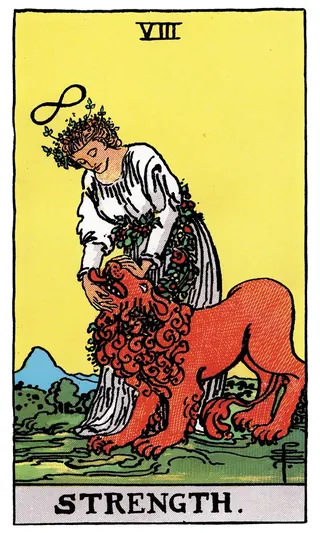
Pamela Colman Smith · Rider–Waite–Smith (1909)
These three upright cards are selected as an instructional example, not presented as a random draw or a recorded personal reading. Your own cards may differ; the method is to connect the symbol, position and context.
1. What you have noticed — Page of Cups
The Page of Cups suggests curiosity. In the observation position, name a friendly moment without assuming it proves attraction.
2. What remains ambiguous — Two of Swords
The Two of Swords evokes an unresolved picture. You can recognise that uncertainty instead of treating mixed signals as a hidden yes.
3. A respectful way to ask — Strength
Strength suggests calm and consideration. A modest invitation and a respectful response to her answer can provide clarity without pressure.
Put the example together
Connect what you have noticed with what remains ambiguous, then use a respectful way to ask to identify something you can examine or do. Look for a shared theme and a tension between the cards. If a connection does not fit what you know, do not force it.
Try an alternative interpretation as well. A card about holding on could describe useful stability or fear of change; decide which fits the evidence rather than selecting the version you prefer.
How to read a reversal here
A reversed card uses the reversed keywords shown in your result. Read those themes through the same position. It does not automatically negate the upright card or turn the whole spread into a no. A theme of hesitation, for example, can prompt a question about your own uncertainty without identifying another person’s motive.
Learn more about reversed tarot cards. Use the full card meaning as context, not as a substitute for the facts of your situation.
Cards traditionally read as a sign of interest
When people ask whether she likes them, these are the cards readers usually call warm. Treat each one as a description of the connection you are reading about, not as proof of her private feelings.
| Card | Why it reads as encouraging here |
|---|---|
| Two of Cups | Mutual attraction and an even exchange; the classic picture of two people meeting halfway. |
| Ace of Cups | A fresh emotional opening, often read as feelings starting to flow on both sides. |
| Knight of Cups | Someone approaching with an offer, which can hint that a sweet gesture is welcome. |
| Three of Cups | Easy, playful time together, the kind of friendship where flirting can grow. |
| Six of Cups | Comfort and familiarity; she may feel safe and relaxed around you. |
| The Lovers | Attraction plus a real choice, so it asks whether your values line up too. |
| The Sun | Openness and warmth with nothing hidden; one of the brightest cards for this question. |
| Queen of Wands | Confident, sociable energy, often read as someone who enjoys your attention. |
| Ace of Wands | A spark of chemistry or excitement that wants a next step. |
| The Star | Hope and gentle honesty, suggesting the door is open but nothing is rushed. |
Even a spread full of these cards describes possibility. The real answer still arrives through how she responds to you.
Cards that suggest caution or not right now
A harder card is not a rejection letter. For this question it usually points to distance, mixed motives or bad timing, and it asks you to protect your own dignity while you find out more.
- Four of Cups: She may be distracted, uninterested or simply not looking at what is being offered.
- Eight of Cups: Someone turning away from an emotional situation; she may be moving on.
- The Moon: Projection and confusion; you may be filling gaps with hope rather than facts.
- The Hermit: A person who needs space or solitude right now, whatever she feels about you.
- Queen of Swords: Clear boundaries; read it as a reminder to take her words at face value.
- Three of Swords: Hurt somewhere in the picture, possibly an old wound or a recent heartbreak.
- Seven of Cups: Fantasy and too many options; the idea of her may be bigger than the reality.
- Five of Wands: Friction, competition or crossed signals inside a friend group.
- Nine of Swords: Your own late-night worry, which can distort ordinary behavior into a verdict.
If several of these cluster together, slow down. That is guidance about pace, not a judgment of your worth.
Reading a mixed or confusing draw
Most real draws are neither a clean yes nor a clean no. Suppose your three positions show Six of Cups, Seven of Cups and Temperance.
The Six of Cups in the first position fits a comfortable, friendly history: shared jokes, years of knowing each other, easy hangouts. The Seven of Cups in the middle says the uncertain part may be your own imagination, with several stories running at once about what she meant. Temperance in the last position recommends a measured step, such as one invitation that mixes the familiar with something slightly new.
Put together, the reading is not saying she likes you or that she does not. It says there is real warmth, that you may be over-interpreting it, and that a calm, proportionate move will tell you more than any card. When a draw feels contradictory, ask which card describes a fact and which describes a feeling. Facts usually deserve more weight. If you want a single-card check afterward, the yes or no tarot tool works, but only once.
When will I know if she likes me?
Tarot has no built-in clock. Readers use timing conventions that are traditions of practice, not established facts, and they disagree with one another. A common version reads Wands as days to weeks, Cups as weeks to months, Swords as fast but unsettled, and Pentacles as slow and steady. Some readers flip Swords and Pentacles. Court cards are sometimes read with Pages as very soon and Kings as later.
If you notice Eight of Wands in your spread, many readers say messages or movement may come quickly. If you see Four of Swords, they read a pause. Use that as a mood, not a deadline.
The honest timeline is the one you set by acting. You will usually know more within a week or two of a clear, low-key invitation: whether she accepts, suggests another time, or politely declines. Watch for whether she follows through on plans and whether she starts contact herself. Those patterns answer the timing question far better than any suit.
What to do after a does she like me reading
- Write down two or three specific moments with her and what actually happened, without guessing at motives.
- Pick one invitation that fits your current relationship: coffee, a walk, an event you both enjoy.
- Ask in a way that makes no easy to say. A simple, friendly question beats hints she has to decode.
- Accept her answer the first time. A no, or a vague maybe that keeps moving, is information.
- Keep your friendship, work and social life steady either way, so one answer does not carry your whole week.
Stop asking the cards once you have made your move or decided not to. Drawing again on the same question tends to feed anxiety rather than clarity. If you notice you are checking her social media, re-reading messages or drawing daily, talk it over with a friend you trust. If rejection feels unbearable or the worry is constant, a counselor can help with the pattern underneath. For a different angle on the same situation, see how does he feel about me, or talk it through on love chat.
Real-life signs that matter more than any card
The most reliable sign of interest is reciprocity: effort that flows both ways without you having to engineer it.
- She asks you questions back and remembers details you shared.
- She suggests plans or offers times when she cannot make yours.
- She makes time for one-on-one conversation, not only group settings.
- Her behavior is consistent in person and over text, not only when she is bored.
- She is comfortable with friendly physical cues and you are reading them carefully, never assuming.
Signs that are easy to misread include being kind to everyone, being polite at work or in a service role, and replying quickly simply because she is a fast texter. Friendliness is a lovely thing on its own; it does not have to be a hidden message. If you are unsure, the clearest sign of all is the answer she gives when you ask her directly and kindly.
Practical checks after this reading
- Describe actual interactions without claiming to know a motive.
- Make an invitation appropriate to your existing relationship.
- Accept her response without trying to reinterpret a refusal.
Record the cards, one possible interpretation and one fact that would help you evaluate it. If the draw does not fit, leave it aside. Repeating a draw until it feels reassuring does not make the result more informative.
Choose the question you actually mean
These related spreads examine different questions; one answer should not be used to settle the others.
More tarot readings by question
Love and attraction
- Does he like me?
- How does he feel about me?
- Is he thinking about me?
- Does he miss me?
- Will he text me?
- Should I text him?
- Is he the one?
- Will he commit?
- Will I find love?
- When will I meet my soulmate?
- Future husband tarot
- Will I get married?
Exes and second chances
- Will he come back?
- Will she come back?
- Does my ex still love me?
- Will my ex contact me?
- Will we get back together?
- Should I forgive him?
- Should I stay or leave?
Work, money and study
- Will I get the job?
- Will I get promoted?
- Should I quit my job?
- Should I change careers?
- Will my business succeed?
- Will my finances improve?
- Will I pass my exam?
Life decisions
Frequently asked questions
Can this reading answer “Does she like me?” with certainty?
Interest can be hard to distinguish from friendliness, especially when you already hope she likes you. This spread explores what you have noticed, what remains ambiguous and how to invite clearer communication without pressure. It cannot establish her attraction.
How is this spread different from the other readings?
This spread uses what you have noticed, what remains ambiguous and a respectful way to ask. Its worked example and practical checks focus on this question. It does not use a generic yes/no score.
Does typing my question change the interpretation?
No. The optional note is for your own context. Cards are drawn at random in your browser, and the prompts are written for the positions on this page. No AI analyses your note in this tool.
What should I do with an unclear or uncomfortable reading?
Record one possible interpretation and compare it with what you know. If it does not fit, you can leave it aside. Another draw cannot establish a missing fact; use a conversation, records or other relevant information instead.
Method and further reading
This tool uses the site’s Rider–Waite–Smith card keywords with question-specific reflection prompts. It does not analyse your optional note with AI, infer hidden information or calculate the likelihood of an outcome. The worked example explains how to apply the positions.
Learn to read a complete tarot spread · All 78 card meanings · How our tools work