A quiet phone can make a small uncertainty feel much larger. This spread examines the expectation behind the message, the actual communication pattern and a useful next step while you wait. It cannot tell you whether a text is on its way.
For reflection and entertainment. Tarot and AI readings don't predict the future and aren't financial, medical, legal or psychological advice. Use them as a prompt to think, not as a decision.
Will he text me? Draw your three cards
Free, no signup. Three distinct cards are drawn at random from the full 78-card deck. Each has a one-in-three chance of appearing reversed.
This random draw does not establish an outcome, reveal another person’s private thoughts or give a date. Use it as a prompt; check facts separately.
The three positions for this question
Set these positions before drawing. Read each card through its position instead of applying the same meaning to all three.
1. What you want the text to mean
Connect the symbol to the reassurance or information you hope a text would provide. Could one message actually answer that larger question?
2. The communication pattern
Use the card to examine who initiates and follows through over time. What ordinary explanations are possible for this particular silence?
3. What you can do now
Use this symbol to choose whether to send an appropriate message, wait with a checking limit or put your attention somewhere else.
Keep this question in focus
A reply can tell you that he chose to reply at that moment; it cannot settle the whole relationship. Avoid turning response speed into a complete theory of his feelings. Look at the wider pattern and the communication you both find reasonable.
A complete example for “Will he text me?”
What you want the text to mean
The communication pattern
What you can do now
Pamela Colman Smith · Rider–Waite–Smith (1909)
These three upright cards are selected as an instructional example, not presented as a random draw or a recorded personal reading. Your own cards may differ; the method is to connect the symbol, position and context.
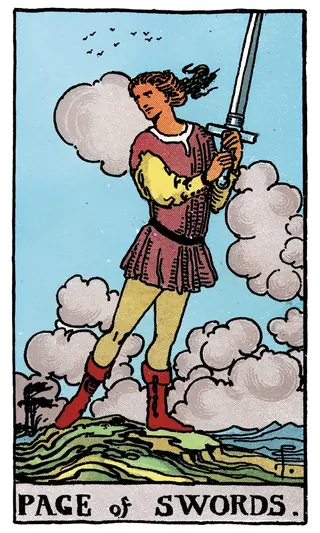
1. What you want the text to mean — Page of Swords
The Page of Swords can symbolise alert attention. In the first position, it may prompt you to notice how closely you are monitoring the phone.
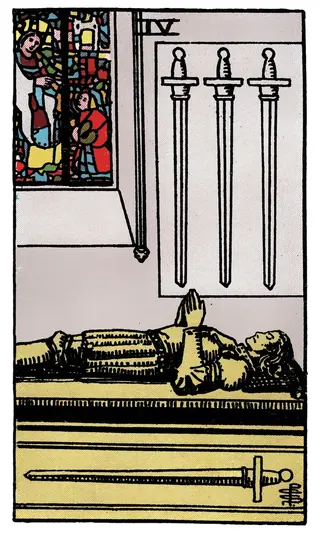
2. The communication pattern — Four of Swords
The Four of Swords suggests a pause. It does not prove rejection or predict a reply; it invites you to allow for incomplete information.
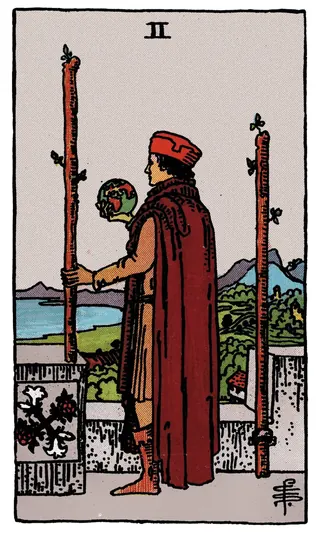
3. What you can do now — Two of Wands
The Two of Wands suggests choosing a direction. Decide what you want to do with your evening instead of leaving the whole plan dependent on a text.
Put the example together
Connect what you want the text to mean with the communication pattern, then use what you can do now to identify something you can examine or do. Look for a shared theme and a tension between the cards. If a connection does not fit what you know, do not force it.
Try an alternative interpretation as well. A card about holding on could describe useful stability or fear of change; decide which fits the evidence rather than selecting the version you prefer.
How to read a reversal here
A reversed card uses the reversed keywords shown in your result. Read those themes through the same position. It does not automatically negate the upright card or turn the whole spread into a no. A theme of hesitation, for example, can prompt a question about your own uncertainty without identifying another person’s motive.
Learn more about reversed tarot cards. Use the full card meaning as context, not as a substitute for the facts of your situation.
Cards often read as “a message is coming”
Readers have a short list of cards they associate with communication and outreach. When these appear, the reading is usually taken as a hopeful sign that contact is possible.
- Eight of Wands: the traditional messenger card: news, calls and texts in motion.
- Page of Cups: a sweet or playful note, sometimes an unexpected emoji-filled hello.
- Knight of Cups: someone reaching out with feeling, often read as a romantic check-in.
- Page of Wands: excited news or a quick, spontaneous message.
- Ace of Swords: a clear, honest communication that clears the air.
- The Magician: initiative; he has the means and the will to make contact.
- Six of Cups: a nostalgic reach-out, common when someone from the past gets back in touch.
- Ace of Wands: a spark of energy that moves someone to act first.
- Wheel of Fortune: a turn in circumstances that gets things moving again.
- The Star: renewed hope and openness after a quiet spell.
Even the Eight of Wands only describes movement. Whether that movement is a text from him, news from someone else or your own decision to reach out is something the card cannot settle.
Cards often read as silence or a pause
These cards are traditionally read as a no, not yet or not in the way you hope. They do not say that you did something wrong.
- The Hanged Man: suspension; nothing may move for a while, and that is out of your hands.
- The Hermit: turning inward, perhaps busy, withdrawn or simply not in a texting mood.
- Two of Swords: a blocked decision; he may be unsure what to say.
- Four of Cups: indifference or distraction, attention focused elsewhere.
- Five of Cups: regret over something said, which can delay a reply.
- Seven of Swords: avoidance or evasion rather than open communication.
- The Moon: confusion and unclear signals on both sides.
- Knight of Swords: a hasty message that may not be the kind you want.
- Nine of Swords: your own anxiety at night, imagining the worst while the phone is dark.
When a silence card appears, the kindest move is usually to put the phone down and turn your attention to something you enjoy.
Making sense of a mixed “will he text me” draw
Suppose your spread shows Eight of Wands, The Hermit and Page of Cups. At first glance it seems to say yes, no and yes again.
The Eight of Wands suggests that communication is in the air, but The Hermit places a solitary figure between that movement and the outcome. A common reading is that he may be wrapped up in his own world for a time: work, family, stress or just a need for quiet. The Page of Cups at the end hints at something tender and low-key, the kind of casual “hey, how are you” that can arrive after a gap.
The lesson of this draw is patience without obsession. It does not promise a message, but it does suggest that silence and interest can exist together. In any mixed draw for this question, give extra attention to the middle card, because it often describes what is happening on his side, and remember that you can only manage your own side. A spread like this also works as a reminder that people go quiet for reasons that have nothing to do with you.
When will he text? What tarot can and cannot say
Questions about exact days are where tarot is weakest. A traditional shortcut links Wands with days, Swords with weeks, Cups with months and Pentacles with longer periods, while other readers assign seasons to each suit. Treat any such answer as a symbolic tempo rather than a schedule to check your phone against.
The Eight of Wands is the card most often read as fast news, and the Four of Swords as a deliberate rest. Neither tells you the hour.
What actually predicts a reply is far more ordinary. How quickly does he usually respond? Who sent the last message, and did it ask a question? Is he traveling, working late or dealing with something you know about? A text sent without a question often gets a slower answer. If you have already reached out clearly once, the ball is in his court, and waiting is the reply you can give. Silence after one clear message is also an answer, even if it is not the one you wanted.
What to do while you wait for his text
- Look at your last message. If it was clear and kind, there is nothing more to fix.
- Resist sending several follow-ups in a row; one message is enough to show interest.
- Mute the conversation for a set number of hours and plan something absorbing in that window.
- If he asked for space or no contact, respect it fully, whatever the cards show.
- Decide in advance how long a silence is acceptable before you move your attention elsewhere.
- Text a friend instead, or call someone who makes you laugh; connection helps more than refreshing a screen.
Pulling cards every hour on the same question tends to feed the anxiety it is meant to calm. One reading is enough; then let real life answer. If you are torn about reaching out, the should I text him spread is designed for that choice. When waiting for messages starts to affect your sleep, eating or work, a friend or counselor can help you step out of the loop.
Practical checks after this reading
- Check whether you have already sent a clear message.
- Avoid escalating repeated messages to force a response.
- Decide when you will next check the phone, then follow your own plan.
Record the cards, one possible interpretation and one fact that would help you evaluate it. If the draw does not fit, leave it aside. Repeating a draw until it feels reassuring does not make the result more informative.
Choose the question you actually mean
These related spreads examine different questions; one answer should not be used to settle the others.
More tarot readings by question
Love and attraction
- Does he like me?
- Does she like me?
- How does he feel about me?
- Is he thinking about me?
- Does he miss me?
- Should I text him?
- Is he the one?
- Will he commit?
- Will I find love?
- When will I meet my soulmate?
- Future husband tarot
- Will I get married?
Exes and second chances
- Will he come back?
- Will she come back?
- Does my ex still love me?
- Will my ex contact me?
- Will we get back together?
- Should I forgive him?
- Should I stay or leave?
Work, money and study
- Will I get the job?
- Will I get promoted?
- Should I quit my job?
- Should I change careers?
- Will my business succeed?
- Will my finances improve?
- Will I pass my exam?
Life decisions
Frequently asked questions
Can this reading answer “Will he text me?” with certainty?
A quiet phone can make a small uncertainty feel much larger. This spread examines the expectation behind the message, the actual communication pattern and a useful next step while you wait. It cannot tell you whether a text is on its way.
How is this spread different from the other readings?
This spread uses what you want the text to mean, the communication pattern and what you can do now. Its worked example and practical checks focus on this question. It does not use a generic yes/no score.
Does typing my question change the interpretation?
No. The optional note is for your own context. Cards are drawn at random in your browser, and the prompts are written for the positions on this page. No AI analyses your note in this tool.
What should I do with an unclear or uncomfortable reading?
Record one possible interpretation and compare it with what you know. If it does not fit, you can leave it aside. Another draw cannot establish a missing fact; use a conversation, records or other relevant information instead.
Method and further reading
This tool uses the site’s Rider–Waite–Smith card keywords with question-specific reflection prompts. It does not analyse your optional note with AI, infer hidden information or calculate the likelihood of an outcome. The worked example explains how to apply the positions.
Learn to read a complete tarot spread · All 78 card meanings · How our tools work