A career change is larger than escaping a difficult job. This spread explores what draws you toward another field, the gap between interest and readiness and an experiment that can test the idea. It cannot guarantee that a new profession will suit you.
For reflection and entertainment. Tarot and AI readings don't predict the future and aren't financial, medical, legal or psychological advice. Use them as a prompt to think, not as a decision.
Should I change careers? Draw your three cards
Free, no signup. Three distinct cards are drawn at random from the full 78-card deck. Each has a one-in-three chance of appearing reversed.
This random draw does not establish an outcome, reveal another person’s private thoughts or give a date. Use it as a prompt; check facts separately.
The three positions for this question
Set these positions before drawing. Read each card through its position instead of applying the same meaning to all three.
1. What draws you to the new field
Use this symbol to identify which tasks or values attract you. What evidence suggests you enjoy the work itself, not only its image?
2. The skills and reality gap
Read the card as a prompt about training, entry requirements and transferable skills. Which assumptions about the new field still need checking?
3. A small career experiment
Use the symbol to design a small test: an informational conversation, a sample project or an introductory class before a major commitment.
Keep this question in focus
You do not need to decide everything at once. Separate the attraction of the new field from dissatisfaction with your current workplace. Learn what an ordinary working day in the new field involves, including tasks you might not enjoy.
A complete example for “Should I change careers?”
What draws you to the new field
The skills and reality gap
A small career experiment
Pamela Colman Smith · Rider–Waite–Smith (1909)
These three upright cards are selected as an instructional example, not presented as a random draw or a recorded personal reading. Your own cards may differ; the method is to connect the symbol, position and context.
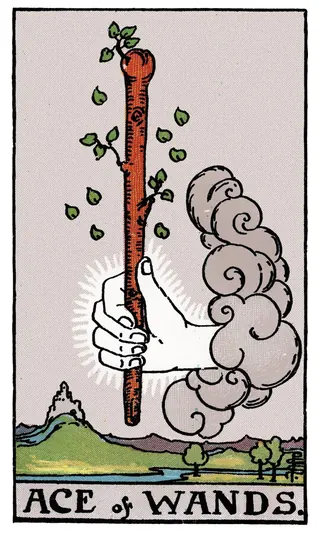
1. What draws you to the new field — Ace of Wands
The Ace of Wands can capture initial enthusiasm. In the first position, connect that enthusiasm to specific work you want to do.
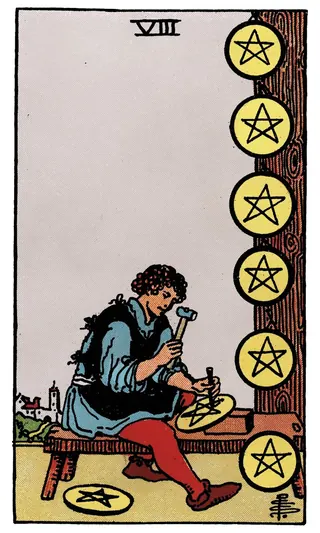
2. The skills and reality gap — Eight of Pentacles
The Eight of Pentacles suggests practice. In the gap position, identify a skill you need to demonstrate rather than treating motivation as readiness.
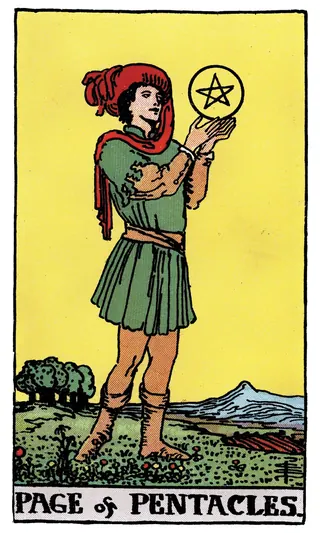
3. A small career experiment — Page of Pentacles
The Page of Pentacles supports a modest learning trial. Completing one sample task gives you a clearer basis for deciding whether to explore further.
Put the example together
Connect what draws you to the new field with the skills and reality gap, then use a small career experiment to identify something you can examine or do. Look for a shared theme and a tension between the cards. If a connection does not fit what you know, do not force it.
Try an alternative interpretation as well. A card about holding on could describe useful stability or fear of change; decide which fits the evidence rather than selecting the version you prefer.
How to read a reversal here
A reversed card uses the reversed keywords shown in your result. Read those themes through the same position. It does not automatically negate the upright card or turn the whole spread into a no. A theme of hesitation, for example, can prompt a question about your own uncertainty without identifying another person’s motive.
Learn more about reversed tarot cards. Use the full card meaning as context, not as a substitute for the facts of your situation.
Cards traditionally read as a green light for a career change
For a career change, encouraging cards usually show momentum, transferable skill or a calling with substance behind it. They support exploring the new field seriously; they do not tell you to resign tomorrow.
- The Fool: a leap into unfamiliar work, best read as permission to start learning, not to skip planning.
- Three of Wands: expansion and looking past your current horizon toward a wider field.
- Three of Pentacles: skills that other people recognize and that can travel to a new team.
- Six of Swords: moving from a draining situation toward calmer working conditions.
- The Magician: resourcefulness; you may already hold more of the needed tools than you think.
- The Chariot: a change driven by clear will and sustained effort.
- Knight of Pentacles: steady, methodical progress through a retraining plan.
- Wheel of Fortune: a turning point in your working life that is worth noticing.
- The Star: renewed purpose after burnout; work that feels aligned again.
- Page of Wands: curiosity about a new field and the energy to explore it.
- The World: one professional chapter reaching completion so another can begin.
Cards that counsel caution or more preparation
Caution cards in a career reading rarely mean the new path is wrong. More often they point to timing, money or exhaustion that needs attention before you move.
- Four of Pentacles: security matters; build a financial cushion first.
- Seven of Cups: many options and some fantasy; the new field may be idealized.
- The Hanged Man: a deliberate pause or a change of perspective before acting.
- Five of Pentacles: financial strain; budget the transition before you leap.
- Ten of Wands: overload; you may need rest more than a new profession.
- The Moon: unclear information; research what the job really involves.
- Eight of Swords: feeling trapped, though more options may exist than the dramatic one.
- Four of Swords: recovery first; decisions made while exhausted are often reactive.
- The Tower: sudden upheaval, sometimes a forced change rather than a chosen one; plan for stability.
- Five of Wands: competition; expect a crowded entry into the new field.
When the cards pull in two directions
Suppose your three cards are The Chariot, the Four of Pentacles and the Page of Wands. Drive is clearly present. Money security is a real constraint. The final card suggests approaching the new field as a learner. Read together, the message is "go, but slowly": keep your current income while you test the idea on the side.
Another useful check is suit balance. A spread heavy in Pentacles points to practical questions such as pay, training costs and stability. Wands lean toward motivation and ambition, Swords toward mental conflict and overthinking, and Cups toward how the work would feel day to day. Major Arcana cards suggest the decision touches your sense of identity, not just your job title. A mixed career draw very often means yes to the direction and not yet to the timing, which is a perfectly workable answer. If one card is reversed, read it as the area where the plan is still weak, then go and strengthen that area before drawing on the question again.
How long a career change takes: symbolic versus real timelines
Some readers say Pentacles move slowly and Wands move fast, and some link each suit to a season. Treat these as conventions that differ between teachers, not as a schedule for your life. A card cannot know how long your licensing exam or certificate program takes.
Real timing comes from the occupation itself. O*NET OnLine, sponsored by the U.S. Department of Labor, profiles more than 900 occupations, including the education, training and experience each typically requires. Look up the job you are considering: a role that needs a short certificate might take months to enter, while one that needs a degree or license can take years. Plan around that, not around a suit.
Watch these markers as well: whether your interest survives a month of research, whether people in the field describe the work you imagined, and whether you can cover your expenses during the training period. Those three answers usually settle the "when" better than any draw. A change that takes two years of evening classes is still a change; slow is not the same as never.
Practical next steps after a career reading
- Write down the exact role you are considering, not just "something creative" or "anything else."
- Read its O*NET profile and note the tasks you would do every week, including the dull ones.
- Ask two people who do that job what surprised them after their first year.
- Calculate how many months of expenses you could cover if your income dropped during the switch.
- Try a weekend project, a volunteer shift or a short course, then set a date to decide.
Once your remaining questions are factual, such as salary, requirements or openings, the cards have done their job; stop drawing and gather data. A career counselor or a mentor already working in the field can test your plan in ways tarot cannot. If you want to talk your options through first, our free career psychic chat is available, and the will I get the job spread suits the application stage. If work stress is affecting your health or sleep, see a doctor or therapist before making a major move.
Practical checks after this reading
- Compare the new field with a better role in your current one.
- Verify entry requirements and everyday tasks.
- Run one small experiment and evaluate both enjoyment and difficulty.
Record the cards, one possible interpretation and one fact that would help you evaluate it. If the draw does not fit, leave it aside. Repeating a draw until it feels reassuring does not make the result more informative.
Choose the question you actually mean
These related spreads examine different questions; one answer should not be used to settle the others.
More tarot readings by question
Love and attraction
- Does he like me?
- Does she like me?
- How does he feel about me?
- Is he thinking about me?
- Does he miss me?
- Will he text me?
- Should I text him?
- Is he the one?
- Will he commit?
- Will I find love?
- When will I meet my soulmate?
- Future husband tarot
- Will I get married?
Exes and second chances
- Will he come back?
- Will she come back?
- Does my ex still love me?
- Will my ex contact me?
- Will we get back together?
- Should I forgive him?
- Should I stay or leave?
Work, money and study
- Will I get the job?
- Will I get promoted?
- Should I quit my job?
- Will my business succeed?
- Will my finances improve?
- Will I pass my exam?
Life decisions
Frequently asked questions
Can this reading answer “Should I change careers?” with certainty?
A career change is larger than escaping a difficult job. This spread explores what draws you toward another field, the gap between interest and readiness and an experiment that can test the idea. It cannot guarantee that a new profession will suit you.
How is this spread different from the other readings?
This spread uses what draws you to the new field, the skills and reality gap and a small career experiment. Its worked example and practical checks focus on this question. It does not use a generic yes/no score.
Does typing my question change the interpretation?
No. The optional note is for your own context. Cards are drawn at random in your browser, and the prompts are written for the positions on this page. No AI analyses your note in this tool.
What should I do with an unclear or uncomfortable reading?
Record one possible interpretation and compare it with what you know. If it does not fit, you can leave it aside. Another draw cannot establish a missing fact; use a conversation, records or other relevant information instead.
Method and further reading
This tool uses the site’s Rider–Waite–Smith card keywords with question-specific reflection prompts. It does not analyse your optional note with AI, infer hidden information or calculate the likelihood of an outcome. The worked example explains how to apply the positions.
Learn to read a complete tarot spread · All 78 card meanings · How our tools work
Sources cited on this page:
- O*NET OnLine · U.S. Department of Labor, Employment and Training Administration