Marriage involves preferences, another person's consent and practical choices. This spread helps you explore why marriage matters to you, the conditions for a compatible commitment and a conversation or step you can take. It cannot predict a wedding.
For reflection and entertainment. Tarot and AI readings don't predict the future and aren't financial, medical, legal or psychological advice. Use them as a prompt to think, not as a decision.
Will I get married? Draw your three cards
Free, no signup. Three distinct cards are drawn at random from the full 78-card deck. Each has a one-in-three chance of appearing reversed.
This random draw does not establish an outcome, reveal another person’s private thoughts or give a date. Use it as a prompt; check facts separately.
The three positions for this question
Set these positions before drawing. Read each card through its position instead of applying the same meaning to all three.
1. What marriage means to you
Use the symbol to explore your own reasons for wanting marriage. Which come from your values and which from expectations around you?
2. Conditions for mutual commitment
Read this card as a prompt about consent, compatibility and practical agreements. What conditions would make marriage a choice both people want?
3. A conversation or next step
Use the symbol to choose a discussion or clarification you control. What question about commitment needs an honest answer?
Keep this question in focus
If you are partnered, ask what you have actually agreed about marriage. If you are single, clarify whether you want marriage itself or the security and belonging you associate with it. Neither a positive card nor a difficult one determines your future marital status.
A complete example for “Will I get married?”
What marriage means to you
Conditions for mutual commitment
A conversation or next step
Pamela Colman Smith · Rider–Waite–Smith (1909)
These three upright cards are selected as an instructional example, not presented as a random draw or a recorded personal reading. Your own cards may differ; the method is to connect the symbol, position and context.
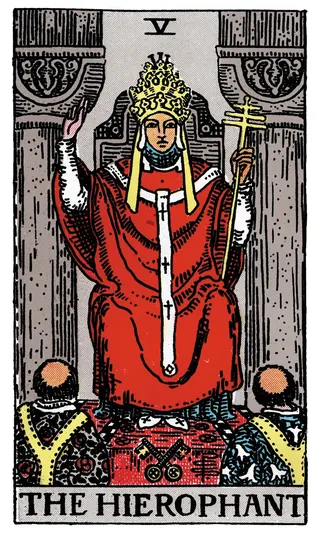
1. What marriage means to you — The Hierophant
The Hierophant evokes formal commitments and tradition. It helps examine the meaning of marriage without predicting a ceremony.
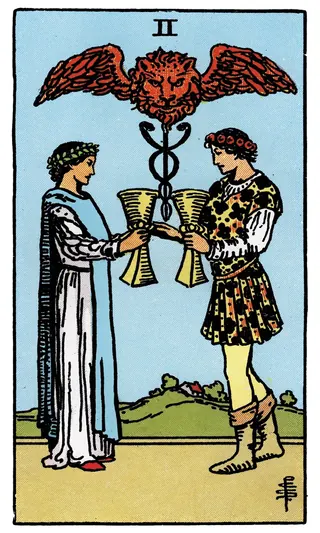
2. Conditions for mutual commitment — Two of Cups
The Two of Cups highlights reciprocity. In the conditions position, ask whether both people want the same agreement.
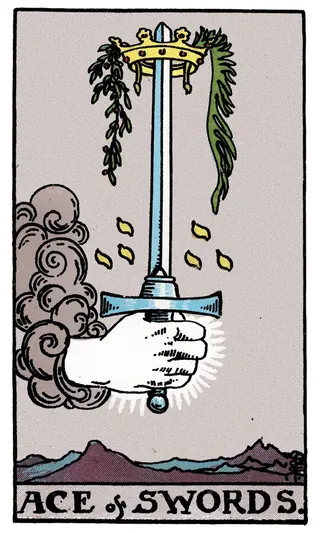
3. A conversation or next step — Ace of Swords
The Ace of Swords suggests plain language. A direct conversation about marriage is more informative than treating the card as a proposal.
Put the example together
Connect what marriage means to you with conditions for mutual commitment, then use a conversation or next step to identify something you can examine or do. Look for a shared theme and a tension between the cards. If a connection does not fit what you know, do not force it.
Try an alternative interpretation as well. A card about holding on could describe useful stability or fear of change; decide which fits the evidence rather than selecting the version you prefer.
How to read a reversal here
A reversed card uses the reversed keywords shown in your result. Read those themes through the same position. It does not automatically negate the upright card or turn the whole spread into a no. A theme of hesitation, for example, can prompt a question about your own uncertainty without identifying another person’s motive.
Learn more about reversed tarot cards. Use the full card meaning as context, not as a substitute for the facts of your situation.
Cards traditionally read as marriage or lasting commitment
These are the cards most readers associate with weddings, formal vows and a shared home. In your spread they describe hopes and themes; they do not schedule a proposal.
- The Hierophant: the classic card of formal vows, ceremony and tradition.
- Two of Cups: a balanced partnership in which both people choose each other.
- The Lovers: a deep bond built on shared values and a real choice.
- Four of Wands: celebration and homecoming, often read as a wedding party.
- Ten of Cups: emotional fulfillment and a happy family life.
- Ten of Pentacles: long-term security, family ties and a shared legacy.
- Three of Cups: celebrating with friends, sometimes an engagement or shower.
- Justice: contracts and legal agreements, including a marriage license.
- The Empress: nurturing love and a family that grows.
- Ace of Cups: a new emotional beginning that could lead somewhere lasting.
Cards read as a delay, a doubt or "not with this person"
None of these cards means you will never marry. They are traditionally read as obstacles, hesitation or a season of life that is focused elsewhere for now.
- Three of Swords: heartbreak that needs to heal before a new commitment.
- Five of Wands: ongoing conflict about how a shared life would work.
- Knight of Wands: excitement without staying power; commitment may not be on their mind.
- Seven of Cups: idealizing marriage or a partner instead of seeing them clearly.
- The Devil: an unhealthy attachment that should not be locked in with vows.
- Eight of Cups: leaving a relationship that no longer meets your needs.
- Two of Swords: indecision; one or both of you is not ready to choose.
- Four of Cups: indifference or missed opportunities in love.
- The Hermit: a period of solitude and self-knowledge before partnership.
- Nine of Pentacles: a fulfilling independent life; not a no to love, but a yes to yourself.
Reading a mixed draw about marriage
Say you draw the Four of Wands, the Knight of Wands and the Two of Swords. The first card carries the wish for celebration and a settled home. The second describes energy that loves the chase but may not stay put. The third shows a decision nobody is making. If you are partnered, this reads as "you want marriage, your partner's readiness is unclear, and the topic is being avoided." The practical answer is a direct conversation, not another spread.
The same three cards mean something different if you are single. For a single reader, the Knight of Wands may describe the kind of person you keep dating, and the Two of Swords may point to your own ambivalence about settling down. Before reading any marriage spread, write one line stating your situation: single, dating, or in a committed relationship. Then interpret every card through that line. A mixed draw then becomes a precise picture of where the gap lies between the life you want and the one you are currently living.
When will I get married? Tarot timing and the real picture
Many people come to this question with a private deadline, often tied to a birthday or a friend's wedding. Tarot timing cannot meet that need. Suit conventions, such as Cups for months or Pentacles for a slower season, are traditions that change from reader to reader, and none of them is a date.
Real-world context can ease the pressure instead. In 2024 the median age at first marriage in the United States was 30.8 for men and 28.8 for women, according to Bowling Green State University's National Center for Family and Marriage Research, which analyzed Census Bureau survey data. A median means half of first marriages happen later than that, so being unmarried at thirty is ordinary rather than a sign of failure.
Watch real markers instead of cards: whether you and a partner have discussed marriage openly, whether your plans for money, children and location fit together, and whether commitment shows up in daily choices, not only in words.
Next steps after a marriage reading
- If you are partnered, ask a direct question about marriage and timing, and listen to the answer without bargaining.
- Compare your views on money, children, religion and where to live; these predict more than any card.
- Consider premarital counseling if you are already discussing engagement.
- If you are single, check whether your dating choices match the commitment you say you want.
- Notice whose deadline you are trying to meet: yours, your family's or social media's.
Stop drawing on this question when the readings become a way to manage anxiety rather than gain insight; once a month is plenty. A therapist can help if pressure about marriage is affecting your self-worth, and a couples counselor can help when two partners want different things. For a related angle, try when will I meet my soulmate, or talk it through in our love psychic chat.
Real-life signs of commitment that outweigh any card
If you are in a relationship, commitment usually becomes visible long before a ring does. Your partner talks about the future using "we," introduces you to the important people in their life, makes plans a year or more ahead and is open about money. Disagreements get worked through rather than left to fester. On the other hand, a partner who changes the subject every time marriage comes up, answers with "someday" but never anything specific, or lets years pass without any movement is giving you real information, whatever card appears. If you are single, the useful signs are about you: whether you are meeting people who also want a long-term partnership, and whether you feel ready to share daily life. It is also worth remembering that marriage is one route to a fulfilling life, not the only one, and a reading that says "not yet" leaves plenty of good paths open.
Practical checks after this reading
- Separate personal wishes from social pressure.
- If partnered, discuss whether both people want marriage.
- Avoid deadlines derived from card suits or repeated draws.
Record the cards, one possible interpretation and one fact that would help you evaluate it. If the draw does not fit, leave it aside. Repeating a draw until it feels reassuring does not make the result more informative.
Choose the question you actually mean
These related spreads examine different questions; one answer should not be used to settle the others.
More tarot readings by question
Love and attraction
- Does he like me?
- Does she like me?
- How does he feel about me?
- Is he thinking about me?
- Does he miss me?
- Will he text me?
- Should I text him?
- Is he the one?
- Will he commit?
- Will I find love?
- When will I meet my soulmate?
- Future husband tarot
Exes and second chances
- Will he come back?
- Will she come back?
- Does my ex still love me?
- Will my ex contact me?
- Will we get back together?
- Should I forgive him?
- Should I stay or leave?
Work, money and study
- Will I get the job?
- Will I get promoted?
- Should I quit my job?
- Should I change careers?
- Will my business succeed?
- Will my finances improve?
- Will I pass my exam?
Life decisions
Frequently asked questions
Can this reading answer “Will I get married?” with certainty?
Marriage involves preferences, another person's consent and practical choices. This spread helps you explore why marriage matters to you, the conditions for a compatible commitment and a conversation or step you can take. It cannot predict a wedding.
How is this spread different from the other readings?
This spread uses what marriage means to you, conditions for mutual commitment and a conversation or next step. Its worked example and practical checks focus on this question. It does not use a generic yes/no score.
Does typing my question change the interpretation?
No. The optional note is for your own context. Cards are drawn at random in your browser, and the prompts are written for the positions on this page. No AI analyses your note in this tool.
What should I do with an unclear or uncomfortable reading?
Record one possible interpretation and compare it with what you know. If it does not fit, you can leave it aside. Another draw cannot establish a missing fact; use a conversation, records or other relevant information instead.
Method and further reading
This tool uses the site’s Rider–Waite–Smith card keywords with question-specific reflection prompts. It does not analyse your optional note with AI, infer hidden information or calculate the likelihood of an outcome. The worked example explains how to apply the positions.
Learn to read a complete tarot spread · All 78 card meanings · How our tools work
Sources cited on this page:
- Median Age at First Marriage: Geographic Variation, 2024 · National Center for Family and Marriage Research, Bowling Green State University