This spread explores the partnership you would want to build with a future husband. It does not identify a person, appearance, profession or wedding date. Use it to reflect on shared values, everyday compatibility and your own readiness for that kind of commitment.
For reflection and entertainment. Tarot and AI readings don't predict the future and aren't financial, medical, legal or psychological advice. Use them as a prompt to think, not as a decision.
Future husband tarot Draw your three cards
Free, no signup. Three distinct cards are drawn at random from the full 78-card deck. Each has a one-in-three chance of appearing reversed.
This random draw does not establish an outcome, reveal another person’s private thoughts or give a date. Use it as a prompt; check facts separately.
The three positions for this question
Set these positions before drawing. Read each card through its position instead of applying the same meaning to all three.
1. Qualities you want in a partnership
Use this symbol to name a quality as a behaviour: kindness, reliability or openness. How would you recognise it over time?
2. Everyday compatibility
Read this card as a prompt about practical compatibility. What would you need to discuss about home, independence, conflict and plans?
3. Your part in building it
Use the symbol to examine your own boundaries and contributions. What can you practise now without waiting for a predicted person?
Keep this question in focus
Court cards can represent qualities, roles or approaches; they do not provide a reliable description of a future man. A useful reading asks how you would recognise respectful behaviour rather than narrowing your search to a predicted age, sign or occupation.
A complete example for “Future husband tarot”
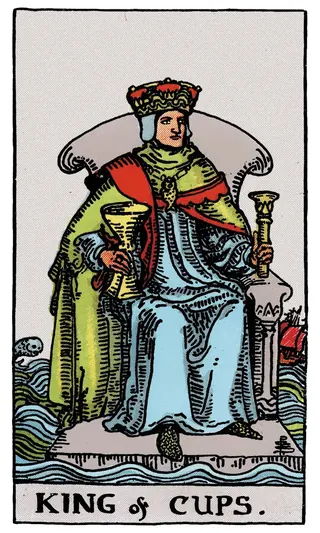
Qualities you want in a partnership
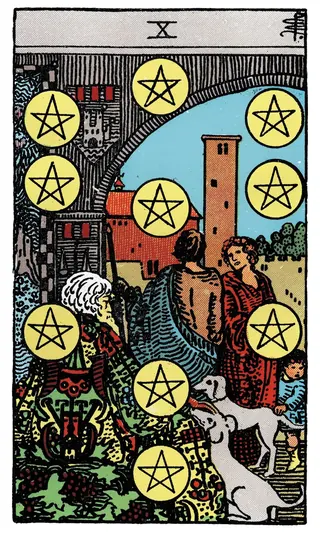
Everyday compatibility
Your part in building it
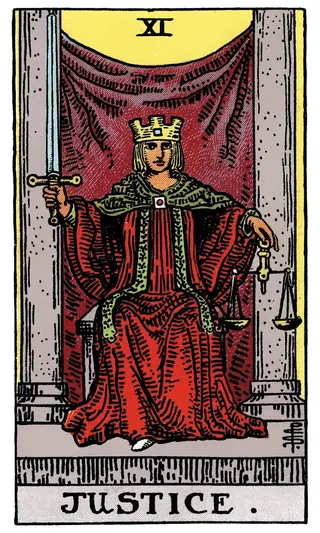
Pamela Colman Smith · Rider–Waite–Smith (1909)
These three upright cards are selected as an instructional example, not presented as a random draw or a recorded personal reading. Your own cards may differ; the method is to connect the symbol, position and context.
1. Qualities you want in a partnership — King of Cups
The King of Cups may symbolise emotional steadiness. It suggests a quality to look for; it does not reveal the personality of a man you have not met.
2. Everyday compatibility — Ten of Pentacles
The Ten of Pentacles raises questions about shared life and family expectations. Discussing those questions matters more than matching a predicted profile.
3. Your part in building it — Justice
Justice highlights fair agreements. You can clarify what a balanced partnership would require from both people.
Put the example together
Connect qualities you want in a partnership with everyday compatibility, then use your part in building it to identify something you can examine or do. Look for a shared theme and a tension between the cards. If a connection does not fit what you know, do not force it.
Try an alternative interpretation as well. A card about holding on could describe useful stability or fear of change; decide which fits the evidence rather than selecting the version you prefer.
How to read a reversal here
A reversed card uses the reversed keywords shown in your result. Read those themes through the same position. It does not automatically negate the upright card or turn the whole spread into a no. A theme of hesitation, for example, can prompt a question about your own uncertainty without identifying another person’s motive.
Learn more about reversed tarot cards. Use the full card meaning as context, not as a substitute for the facts of your situation.
Cards traditionally read as promising for a future husband question
When people ask about a future spouse, readers usually look for cards about mutual choice, emotional safety and a shared home. These are the ones most often read that way, as long as you treat them as qualities to recognize rather than a forecast:
- The Lovers: a conscious, two-sided choice; the emphasis is on values that match, not instant chemistry.
- Two of Cups: mutual respect and an equal exchange, the classic card of a partnership that starts on even footing.
- Ten of Cups: a home life that feels emotionally fulfilling for everyone in it, often read as the long-term picture.
- Four of Wands: celebration, a wedding or housewarming energy, and being welcomed by a wider community.
- The Hierophant: formal commitment and shared traditions; useful for asking whether you want a conventional marriage.
- King of Pentacles: reliability and practical care, a reminder that steadiness is attractive over decades.
- Ace of Cups: a new emotional opening or the first feelings of something serious.
- The Empress: nurturing, abundance and a relationship that helps both people grow.
- Knight of Cups: someone who arrives with an offer or a romantic intention; read it as sincerity, not a deadline.
Cards that suggest caution or a slower path to marriage
None of these cards means you will never marry. In a future husband reading they usually point to something to heal, notice or avoid first, which can save you from settling for the wrong person.
- The Devil: attachment that feels compelling but restrictive; ask whether a pattern of control or dependency keeps repeating.
- Three of Swords: old heartbreak still shaping what you expect from men; grief may need attention before trust can grow.
- Five of Cups: focusing on what was lost, which can make a good person invisible when he appears.
- Seven of Cups: an idealized fantasy husband; too many imagined options and no grounded criteria.
- Eight of Swords: feeling trapped by beliefs such as "it is too late for me," which deserve to be questioned.
- The Hermit: a deliberate season alone; solitude can be preparation rather than rejection.
- Two of Swords: avoiding a decision, perhaps about whether marriage is truly what you want.
- The Tower: a sudden collapse of an assumption, such as a relationship you expected to lead to marriage.
- Five of Wands: constant friction and competition, often read as a warning about choosing conflict as excitement.
Reading a mixed future husband spread
Suppose your three positions show Knight of Wands, The Moon and Six of Pentacles. The first card is energetic and passionate but famously restless. The Moon in the compatibility slot does not say he is dishonest; it says you do not yet have enough information about daily life together. The Six of Pentacles in your own position asks whether you tend to give more than you receive.
Put together, the draw is not a yes or a no. A fair reading is: you are drawn to excitement, the practical picture is unclear, and balance in giving is the thing you can work on. That turns a confusing spread into a useful question, such as "Do I mistake intensity for compatibility?"
When a draw feels contradictory, look for the one card that describes your own behavior and start there. Avoid pulling clarifiers until the cards match the husband you hoped to see; that tends to reflect your wish rather than add information.
When will I meet my future husband? What tarot timing can and cannot say
This is the question most people really want answered, and it is the one tarot handles least reliably. Some readers use a suit convention: Wands for days or weeks, Swords for weeks, Cups for months and Pentacles for a year or more. Others reverse parts of that scheme or link timing to astrological seasons. Because the systems disagree, treat any timing card as a mood about pace, fast and impulsive or slow and steady, not a calendar date.
Real-world context is more grounding than a symbolic date. According to the National Center for Family & Marriage Research, using Census Bureau data, the U.S. median age at first marriage in 2024 was 30.8 for men and 28.8 for women, and it varies widely by state. Plenty of people marry well outside those ages.
Instead of watching for a sign, watch for patterns you can influence: whether you are meeting new people at all, whether you leave relationships that fall short of your values, and whether the people you date talk openly about the future.
What to do after a future husband reading
- Write three non-negotiable values and three flexible preferences, so a card never replaces your own list.
- Pick one realistic way to widen your social circle this month: a class, a volunteer role or an introduction through friends.
- If an old relationship keeps appearing in your readings, consider whether it still shapes your choices.
- Save the reading and revisit it after three months instead of redrawing the same question every night.
Stop asking the cards when you notice you are drawing for reassurance rather than reflection, or when a reading changes how you feel about someone you have not met. If loneliness, pressure from family or a painful past relationship is weighing on you, a trusted friend or a licensed therapist can help more than another spread. For a related angle, try When will I meet my soulmate? or Will I get married?, or explore the tone of a quick yes or no tarot draw.
Real-life signs of husband material that outweigh any card
A spread can help you name what you want, but the evidence that someone could be a good long-term partner shows up slowly, in ordinary moments. These signs are worth more than a beautiful Ten of Cups:
- He behaves the same way with your friends, with waiters and with you when he is tired or stressed.
- Disagreements end with both of you understood, not with one person winning or going silent for days.
- He brings up the future himself, including money, where to live and whether he wants children, and his answers stay consistent.
- Your boundaries are respected the first time you state them, without negotiation or sulking.
- People who care about you feel comfortable around him, and you still feel like yourself.
If those signs are missing, a hopeful card does not cancel them out. If they are present, a cautious card is a prompt to talk openly, not a reason to run.
Practical checks after this reading
- Describe desired qualities through repeated behaviour.
- Avoid using court cards to predict physical traits or identity.
- Discuss practical compatibility before making long-term assumptions.
Record the cards, one possible interpretation and one fact that would help you evaluate it. If the draw does not fit, leave it aside. Repeating a draw until it feels reassuring does not make the result more informative.
Choose the question you actually mean
These related spreads examine different questions; one answer should not be used to settle the others.
More tarot readings by question
Love and attraction
- Does he like me?
- Does she like me?
- How does he feel about me?
- Is he thinking about me?
- Does he miss me?
- Will he text me?
- Should I text him?
- Is he the one?
- Will he commit?
- Will I find love?
- When will I meet my soulmate?
- Will I get married?
Exes and second chances
- Will he come back?
- Will she come back?
- Does my ex still love me?
- Will my ex contact me?
- Will we get back together?
- Should I forgive him?
- Should I stay or leave?
Work, money and study
- Will I get the job?
- Will I get promoted?
- Should I quit my job?
- Should I change careers?
- Will my business succeed?
- Will my finances improve?
- Will I pass my exam?
Life decisions
Frequently asked questions
Can this reading answer “Future husband tarot” with certainty?
This spread explores the partnership you would want to build with a future husband. It does not identify a person, appearance, profession or wedding date. Use it to reflect on shared values, everyday compatibility and your own readiness for that kind of commitment.
How is this spread different from the other readings?
This spread uses qualities you want in a partnership, everyday compatibility and your part in building it. Its worked example and practical checks focus on this question. It does not use a generic yes/no score.
Does typing my question change the interpretation?
No. The optional note is for your own context. Cards are drawn at random in your browser, and the prompts are written for the positions on this page. No AI analyses your note in this tool.
What should I do with an unclear or uncomfortable reading?
Record one possible interpretation and compare it with what you know. If it does not fit, you can leave it aside. Another draw cannot establish a missing fact; use a conversation, records or other relevant information instead.
Method and further reading
This tool uses the site’s Rider–Waite–Smith card keywords with question-specific reflection prompts. It does not analyse your optional note with AI, infer hidden information or calculate the likelihood of an outcome. The worked example explains how to apply the positions.
Learn to read a complete tarot spread · All 78 card meanings · How our tools work
Sources cited on this page:
- Median Age at First Marriage: Geographic Variation, 2024 · National Center for Family & Marriage Research, Bowling Green State University