This spread helps you separate the problem in your current job from the conditions for leaving it. Reflect on what needs to change, the resources for a transition and a next step before resigning. A card draw cannot assess your employment or finances.
For reflection and entertainment. Tarot and AI readings don't predict the future and aren't financial, medical, legal or psychological advice. Use them as a prompt to think, not as a decision.
Should I quit my job? Draw your three cards
Free, no signup. Three distinct cards are drawn at random from the full 78-card deck. Each has a one-in-three chance of appearing reversed.
This random draw does not establish an outcome, reveal another person’s private thoughts or give a date. Use it as a prompt; check facts separately.
The three positions for this question
Set these positions before drawing. Read each card through its position instead of applying the same meaning to all three.
1. What is no longer working
Use this card to name the specific problem: workload, treatment, pay, meaning or progression. Which part could change without leaving the whole field?
2. Your transition requirements
Read the symbol as a prompt about your actual transition needs. Consider contractual obligations, available support and the uncertainty of the next role.
3. The next check before resigning
Use the card to choose one concrete check: a conversation, application, review of notice terms or comparison with another role.
Keep this question in focus
Leaving a job, changing teams and changing careers are different decisions. First identify whether the problem is the role, working conditions, management or the field itself. A useful reading ends with something you can check rather than an instruction to hand in notice.
A complete example for “Should I quit my job?”
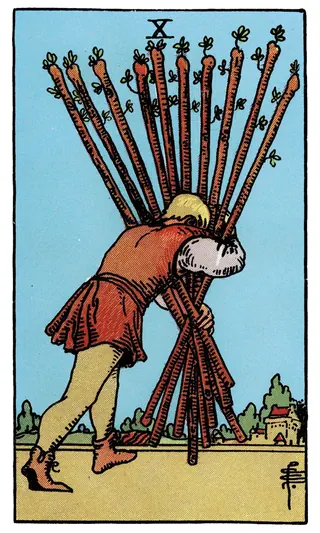
What is no longer working
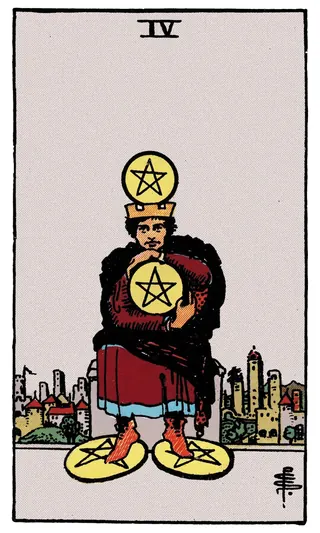
Your transition requirements
The next check before resigning
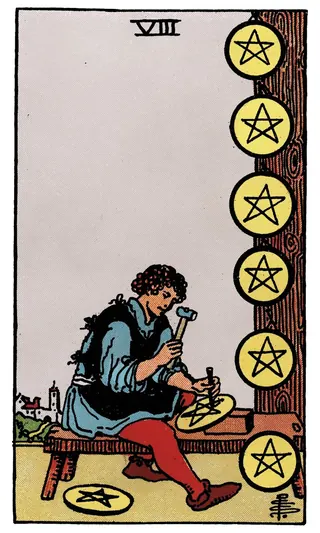
Pamela Colman Smith · Rider–Waite–Smith (1909)
These three upright cards are selected as an instructional example, not presented as a random draw or a recorded personal reading. Your own cards may differ; the method is to connect the symbol, position and context.
1. What is no longer working — Ten of Wands
The Ten of Wands can symbolise overload. In the first position, ask which responsibilities create that load and whether anything can be changed.
2. Your transition requirements — Four of Pentacles
The Four of Pentacles brings stability into focus. In the second position, review the real requirements of leaving rather than assuming a positive card makes the transition affordable.
3. The next check before resigning — Eight of Pentacles
The Eight of Pentacles suggests skill and preparation. Updating examples of your work can be a useful next step before an irreversible decision.
Put the example together
Connect what is no longer working with your transition requirements, then use the next check before resigning to identify something you can examine or do. Look for a shared theme and a tension between the cards. If a connection does not fit what you know, do not force it.
Try an alternative interpretation as well. A card about holding on could describe useful stability or fear of change; decide which fits the evidence rather than selecting the version you prefer.
How to read a reversal here
A reversed card uses the reversed keywords shown in your result. Read those themes through the same position. It does not automatically negate the upright card or turn the whole spread into a no. A theme of hesitation, for example, can prompt a question about your own uncertainty without identifying another person’s motive.
Learn more about reversed tarot cards. Use the full card meaning as context, not as a substitute for the facts of your situation.
Cards often read as support for moving on
In career readings, these cards are traditionally associated with outgrowing a role, finishing a chapter or feeling ready for a new start. They can support planning an exit; they do not replace the plan itself.
- Eight of Cups: leaving a job that stopped feeling meaningful, even if it still looks fine on paper.
- Death: a clear ending; in work questions it often marks a role that has simply run its course.
- Six of Swords: a deliberate move toward calmer conditions, done step by step rather than in a storm.
- The World: completion: you may have learned what this job had to teach you.
- Ace of Wands: a spark of new motivation, often a project or field that genuinely excites you.
- Three of Wands: looking past your current horizon toward opportunities that are already forming.
- Knight of Wands: readiness to act, with a built-in warning against storming out on impulse.
- The Fool: a leap into the unknown that is encouraging, provided you pack a financial safety net.
- Ace of Pentacles: a concrete opening, such as an offer in hand or a side income that is starting to work.
- The Chariot: willpower and direction once you have chosen a route and committed to it.
Cards often read as stay, prepare or not yet
These cards are traditionally read as a reason to pause, build reserves or improve the current role before you resign. None of them is a sentence to stay in a harmful workplace forever.
- Four of Pentacles: protect your financial base before you give anything up.
- Seven of Pentacles: an investment of time that may still pay off; evaluate it before walking away.
- Two of Swords: you are not ready to decide because key information is still missing.
- Five of Pentacles: fear of hardship, a nudge to run the numbers on rent, savings and benefits first.
- Eight of Swords: feeling trapped may be partly perception; list the options you have not tested yet.
- Four of Swords: rest and recovery first, since a burned-out mind makes poor resignation letters.
- The Hanged Man: a deliberate pause and a change of perspective before any move.
- The Hierophant: the established route, such as an internal transfer, a talk with HR or a formal review.
- Nine of Wands: resilience; you may be closer to the end of a hard stretch than it feels.
- Ten of Swords: an ending that has already happened emotionally, asking for recovery before a legal or financial step.
When one card says go and another says wait
A split draw about quitting is often a sequence rather than a contradiction. Take Death, the Four of Pentacles and the Page of Pentacles.
- What is no longer working: Death. The role itself feels finished for you, not just a bad week or one difficult manager.
- Your transition requirements: Four of Pentacles. Money worry is real here. Set a savings target in months of expenses, not a vague "when I feel ready."
- The next check before resigning: Page of Pentacles. A learning step: an informational interview, a short course or a test project in the field you want next.
Put together, the reading says the ending is genuine but the exit is not yet funded. Plan now, leave later. The trap with a draw like this is reading only the card you like best, so write one line for each position before deciding which story the three tell together. You can compare it with the should I change careers reading if the problem is the field, not the employer.
When should I quit? What tarot can and cannot say about timing
Many people ask the cards for a resignation date. Tarot cannot supply one. Readers who use timing at all follow conventions that vary: fiery Wands for days or weeks, Swords for weeks, Cups for weeks to months and earthy Pentacles for months, with the Eight of Wands read as fast movement and the Seven of Pentacles as a slow harvest. Use these as mood, never as a schedule.
The dates that actually shape a good exit are in your paperwork and your bank account:
- Your notice period and any contract terms on non-competes or repayment of training costs.
- Bonus payout dates, 401(k) vesting schedules and unused paid time off.
- Health insurance: the U.S. Department of Labor explains that COBRA lets many workers keep group health coverage for a limited time after leaving, though usually at the full premium.
- A written offer, if you are moving to another role, before you hand in notice.
What to do after a reading about quitting
- Name the problem in one sentence: pay, workload, manager, culture, growth or the field itself.
- Try the fixable version first where it is safe: a direct talk with your manager, a transfer or a leave of absence.
- Count your runway in months of essential expenses, and decide the minimum you need before leaving.
- Update your resume and talk to two people who already do the job you want next.
- Make the decision on a rested day, not straight after a bad meeting.
One draw per decision is plenty; asking again after every tough shift turns the deck into a mood ring. If the job involves harassment, discrimination or unsafe conditions, an employment lawyer or your state labor agency is the right first call, not a card. If work stress is affecting your sleep or health, talk to a doctor or therapist, and check whether your employer offers a confidential assistance program. For a sounding board, the career psychic chat can help you think aloud.
Practical checks after this reading
- Name the job problem precisely.
- Check notice terms and your own transition requirements.
- Compare alternatives before deciding whether resignation is the next step.
Record the cards, one possible interpretation and one fact that would help you evaluate it. If the draw does not fit, leave it aside. Repeating a draw until it feels reassuring does not make the result more informative.
Choose the question you actually mean
These related spreads examine different questions; one answer should not be used to settle the others.
More tarot readings by question
Love and attraction
- Does he like me?
- Does she like me?
- How does he feel about me?
- Is he thinking about me?
- Does he miss me?
- Will he text me?
- Should I text him?
- Is he the one?
- Will he commit?
- Will I find love?
- When will I meet my soulmate?
- Future husband tarot
- Will I get married?
Exes and second chances
- Will he come back?
- Will she come back?
- Does my ex still love me?
- Will my ex contact me?
- Will we get back together?
- Should I forgive him?
- Should I stay or leave?
Work, money and study
- Will I get the job?
- Will I get promoted?
- Should I change careers?
- Will my business succeed?
- Will my finances improve?
- Will I pass my exam?
Life decisions
Frequently asked questions
Can this reading answer “Should I quit my job?” with certainty?
This spread helps you separate the problem in your current job from the conditions for leaving it. Reflect on what needs to change, the resources for a transition and a next step before resigning. A card draw cannot assess your employment or finances.
How is this spread different from the other readings?
This spread uses what is no longer working, your transition requirements and the next check before resigning. Its worked example and practical checks focus on this question. It does not use a generic yes/no score.
Does typing my question change the interpretation?
No. The optional note is for your own context. Cards are drawn at random in your browser, and the prompts are written for the positions on this page. No AI analyses your note in this tool.
What should I do with an unclear or uncomfortable reading?
Record one possible interpretation and compare it with what you know. If it does not fit, you can leave it aside. Another draw cannot establish a missing fact; use a conversation, records or other relevant information instead.
Method and further reading
This tool uses the site’s Rider–Waite–Smith card keywords with question-specific reflection prompts. It does not analyse your optional note with AI, infer hidden information or calculate the likelihood of an outcome. The worked example explains how to apply the positions.
Learn to read a complete tarot spread · All 78 card meanings · How our tools work
Sources cited on this page:
- Continuation of Health Coverage (COBRA) · U.S. Department of Labor