A reunion involves two people making a new agreement. This spread focuses on mutual willingness, the pattern that caused the breakup and the conditions for trying again. It does not predict whether both of you will consent to a relationship.
For reflection and entertainment. Tarot and AI readings don't predict the future and aren't financial, medical, legal or psychological advice. Use them as a prompt to think, not as a decision.
Will we get back together? Draw your three cards
Free, no signup. Three distinct cards are drawn at random from the full 78-card deck. Each has a one-in-three chance of appearing reversed.
This random draw does not establish an outcome, reveal another person’s private thoughts or give a date. Use it as a prompt; check facts separately.
The three positions for this question
Set these positions before drawing. Read each card through its position instead of applying the same meaning to all three.
1. What you would rebuild
Use this card to define the relationship you would want now. Which values and everyday behaviours matter more than the relief of being reunited?
2. The old pattern
Treat the symbol as a question about repeated conflict. What happened before, and what would interrupt that pattern in concrete terms?
3. Conditions for a new agreement
Use this card to identify a condition both people could discuss openly. What evidence would show willingness, responsibility and freedom to choose?
Keep this question in focus
Getting back together requires more than shared affection. Look for a specific agreement about what changes, how conflict will be handled and whether both people can say no freely. If only one person is doing the work, the conditions are not yet mutual.
A complete example for “Will we get back together?”
What you would rebuild
The old pattern
Conditions for a new agreement
Pamela Colman Smith · Rider–Waite–Smith (1909)
These three upright cards are selected as an instructional example, not presented as a random draw or a recorded personal reading. Your own cards may differ; the method is to connect the symbol, position and context.
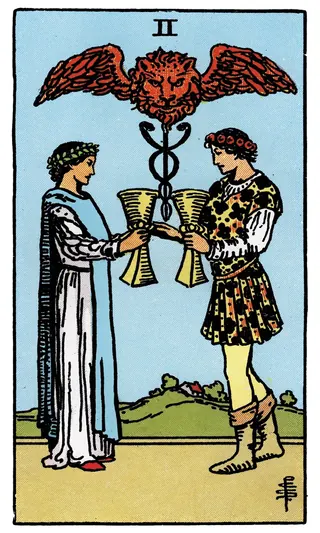
1. What you would rebuild — Two of Cups
The Two of Cups evokes reciprocity. It can help you describe the mutual care you want, but it does not establish that both people currently want a reunion.
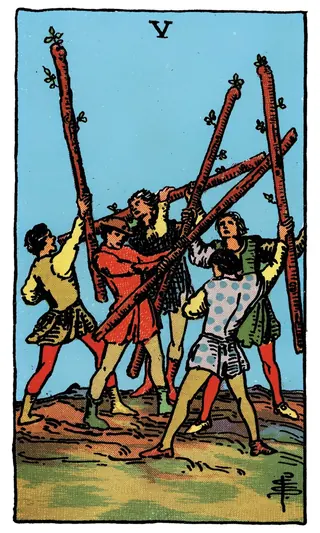
2. The old pattern — Five of Wands
The Five of Wands can symbolise friction. In the middle, it asks you to name the argument pattern and what would prevent another round of it.
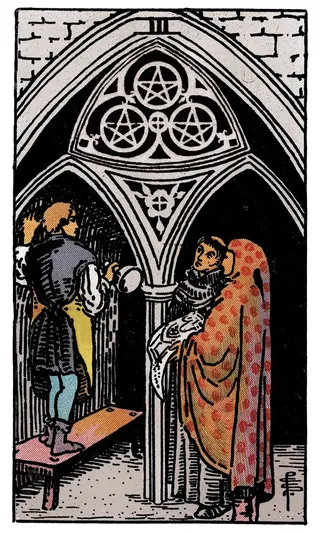
3. Conditions for a new agreement — Three of Pentacles
The Three of Pentacles suggests collaboration. A useful next step is a concrete conversation about expectations, rather than a promise to simply try harder.
Put the example together
Connect what you would rebuild with the old pattern, then use conditions for a new agreement to identify something you can examine or do. Look for a shared theme and a tension between the cards. If a connection does not fit what you know, do not force it.
Try an alternative interpretation as well. A card about holding on could describe useful stability or fear of change; decide which fits the evidence rather than selecting the version you prefer.
How to read a reversal here
A reversed card uses the reversed keywords shown in your result. Read those themes through the same position. It does not automatically negate the upright card or turn the whole spread into a no. A theme of hesitation, for example, can prompt a question about your own uncertainty without identifying another person’s motive.
Learn more about reversed tarot cards. Use the full card meaning as context, not as a substitute for the facts of your situation.
Cards traditionally read as hopeful for a reunion
In reconciliation readings, these cards are usually associated with second chances, healing and two people finding their way back. Remember that a reunion needs two willing people; a hopeful card describes possibility, not the other person's consent.
- Judgement: a second chance that comes with honest accountability and lessons learned.
- Six of Cups: the past coming back into view; warm memories, with a gentle warning about nostalgia.
- The Star: healing and renewed hope after a painful stretch.
- Temperance: patience and a slow blending of two lives again, without rushing.
- Wheel of Fortune: cycles turning, so circumstances that pulled you apart may shift.
- Ace of Cups: a fresh emotional start rather than a copy of the old relationship.
- Strength: the compassion and patience it takes to work through what broke.
- The Lovers: a deliberate choice to recommit, grounded in shared values.
- Six of Pentacles: give and take coming back into balance between you.
- Three of Cups: reconnection through friends and shared social life.
Cards often read as closure or a reason to pause
These cards are traditionally read as an ending, a need for distance or a pattern that would repeat. Painful as they are to see, they can protect you from returning to something that hurt.
- The Tower: the old structure collapsed; rebuilding the same thing may not hold.
- Ten of Swords: a definitive ending, and also the point where recovery starts.
- Three of Swords: heartbreak that is still raw and needs time before any decision.
- Five of Cups: dwelling on the loss while overlooking what is still standing.
- Six of Swords: moving on toward calmer water, often with sadness.
- Eight of Cups: one of you walking away from what no longer fulfilled you.
- The Devil: an on-again, off-again cycle driven by attachment more than choice.
- Five of Swords: winning arguments at the cost of the relationship itself.
- Death: transformation; the old relationship cannot return as it was, even if something new forms.
A closing card is not a punishment. It may simply describe what is already true and invite you to look after yourself.
How to read a hopeful card next to a warning card
Imagine your spread shows Judgement, The Devil and the Four of Swords.
- What you would rebuild: Judgement. You want a real second chance, one where both people own their part. That wish is sincere.
- The old pattern: The Devil. The breakup may have come from a compulsive cycle: jealousy, constant checking or breaking up and making up.
- Conditions for a new agreement: Four of Swords. Rest and genuine distance before any serious talk about trying again.
Read together, the hope is genuine but the first condition is space. Getting back together quickly would likely restart the cycle the middle card describes. Neither card cancels the other; they put things in order. If you are unsure whether you are reading hope or longing, ask yourself what would have to be different in an ordinary week together, and whether the other person has said anything that suggests they want that too. The does my ex still love me reading looks at feelings rather than reunion.
How long until we get back together?
No spread can reliably date a reconciliation, because it depends on two people's choices. Readers who work with timing borrow suit customs: Wands for a matter of days or weeks, Swords for weeks, Cups for weeks or months and Pentacles for months or longer, with The Hanged Man often read as an open-ended wait. These are traditions, and different readers apply them differently.
More meaningful signals live outside the deck. Has your ex reached out on their own, more than once? Have either of you changed the specific behavior that ended things, and can you name how? Has enough time passed that you could talk without old anger taking over? If you agreed to no contact, or they asked for it, that request is the timeline to respect. Healing on your own side is worth the time even if a reunion never comes.
What to do after a reconciliation reading
- Respect any request for space or no contact, whatever the cards show.
- Let yourself grieve; a reunion pursued to avoid sadness tends to repeat the old pattern.
- Write down what would need to be different, in concrete daily terms.
- If you are both talking again, go slowly and consider a few sessions with a couples counselor.
- Choose a date to check in with yourself about how you feel, independent of what your ex does.
Stop drawing on this question when you notice you are reshuffling for a different answer, or when the readings keep you from sleeping or moving forward. A friend who knew you both, or a therapist, can offer the outside view that cards cannot. If the relationship involved threats, control or violence, no card outweighs your safety; the National Domestic Violence Hotline offers confidential support around the clock at 800-799-7233, or by texting START to 88788.
Real-life signs that count more than the cards
Whatever the spread says, these everyday signals say far more about whether a reunion is realistic and healthy:
- Your ex reaches out on their own initiative, in daylight hours, not only when lonely or after a few drinks.
- They name their part in the breakup without being prompted, and you can name yours.
- Their interest stays consistent over weeks rather than flaring up and vanishing.
- They respect your pace and your boundaries, including a "not yet."
- Conversations turn to what would work differently, not just to how good things used to be.
If these signs are absent, a beautiful card is describing your hope rather than the situation. If they are present, take things slowly anyway: a second attempt deserves the same care you would give a new relationship.
Practical checks after this reading
- Ask whether both people have expressed interest in rebuilding.
- Name one conflict pattern and a practical alternative.
- Agree how either person can stop the attempt without pressure.
Record the cards, one possible interpretation and one fact that would help you evaluate it. If the draw does not fit, leave it aside. Repeating a draw until it feels reassuring does not make the result more informative.
Choose the question you actually mean
These related spreads examine different questions; one answer should not be used to settle the others.
More tarot readings by question
Love and attraction
- Does he like me?
- Does she like me?
- How does he feel about me?
- Is he thinking about me?
- Does he miss me?
- Will he text me?
- Should I text him?
- Is he the one?
- Will he commit?
- Will I find love?
- When will I meet my soulmate?
- Future husband tarot
- Will I get married?
Exes and second chances
- Will he come back?
- Will she come back?
- Does my ex still love me?
- Will my ex contact me?
- Should I forgive him?
- Should I stay or leave?
Work, money and study
- Will I get the job?
- Will I get promoted?
- Should I quit my job?
- Should I change careers?
- Will my business succeed?
- Will my finances improve?
- Will I pass my exam?
Life decisions
Frequently asked questions
Can this reading answer “Will we get back together?” with certainty?
A reunion involves two people making a new agreement. This spread focuses on mutual willingness, the pattern that caused the breakup and the conditions for trying again. It does not predict whether both of you will consent to a relationship.
How is this spread different from the other readings?
This spread uses what you would rebuild, the old pattern and conditions for a new agreement. Its worked example and practical checks focus on this question. It does not use a generic yes/no score.
Does typing my question change the interpretation?
No. The optional note is for your own context. Cards are drawn at random in your browser, and the prompts are written for the positions on this page. No AI analyses your note in this tool.
What should I do with an unclear or uncomfortable reading?
Record one possible interpretation and compare it with what you know. If it does not fit, you can leave it aside. Another draw cannot establish a missing fact; use a conversation, records or other relevant information instead.
Method and further reading
This tool uses the site’s Rider–Waite–Smith card keywords with question-specific reflection prompts. It does not analyse your optional note with AI, infer hidden information or calculate the likelihood of an outcome. The worked example explains how to apply the positions.
Learn to read a complete tarot spread · All 78 card meanings · How our tools work
Sources cited on this page:
- National Domestic Violence Hotline · The National Domestic Violence Hotline