An open question works best when you describe the decision clearly. This spread identifies your priority, the trade-off you have been avoiding and a small next step. It offers prompts for a choice you make, not a decision handed down by the cards.
For reflection and entertainment. Tarot and AI readings don't predict the future and aren't financial, medical, legal or psychological advice. Use them as a prompt to think, not as a decision.
What should I do? Draw your three cards
Free, no signup. Three distinct cards are drawn at random from the full 78-card deck. Each has a one-in-three chance of appearing reversed.
This random draw does not establish an outcome, reveal another person’s private thoughts or give a date. Use it as a prompt; check facts separately.
The three positions for this question
Set these positions before drawing. Read each card through its position instead of applying the same meaning to all three.
1. Your main priority
Use this symbol to name the value or need that matters most in this decision. What would a good result actually protect or improve?
2. The trade-off to face
Connect the card to a cost you cannot avoid on every path. Which compromise are you willing to make, and which one crosses a limit?
3. A reversible next step
Translate the symbol into a modest action that produces information. What can you test, ask or check before committing to the whole decision?
Keep this question in focus
When everything feels urgent, choosing one decision to work on is useful. Name the options and the constraint that matters most. You may need more information rather than more confidence; a reversible experiment can reveal more than another broad reading.
A complete example for “What should I do?”
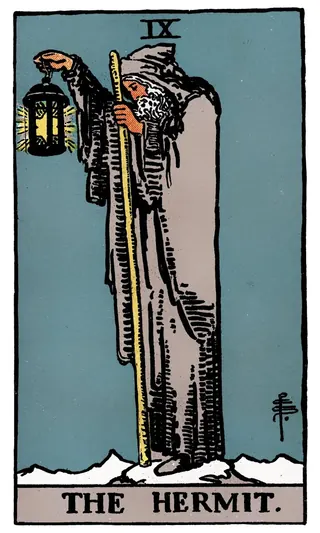
Your main priority
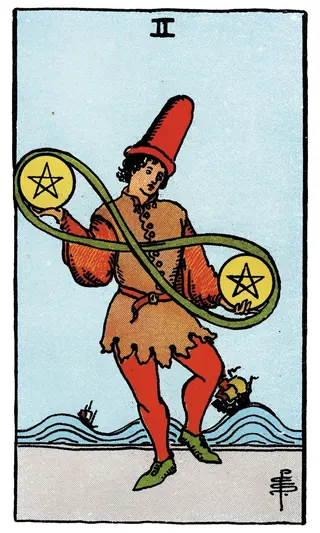
The trade-off to face
A reversible next step
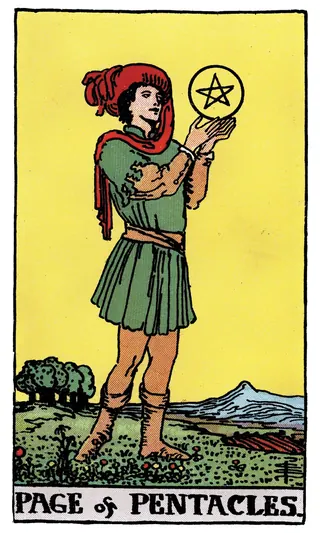
Pamela Colman Smith · Rider–Waite–Smith (1909)
These three upright cards are selected as an instructional example, not presented as a random draw or a recorded personal reading. Your own cards may differ; the method is to connect the symbol, position and context.
1. Your main priority — The Hermit
The Hermit suggests making space to think. In the first position, identify your own priority before collecting another round of opinions.
2. The trade-off to face — Two of Pentacles
The Two of Pentacles highlights competing demands. It asks what must be traded off rather than promising that every option can be kept.
3. A reversible next step — Page of Pentacles
The Page of Pentacles suggests a small learning step. An enquiry, short course or trial task can turn an uncertain idea into something you can evaluate.
Put the example together
Connect your main priority with the trade-off to face, then use a reversible next step to identify something you can examine or do. Look for a shared theme and a tension between the cards. If a connection does not fit what you know, do not force it.
Try an alternative interpretation as well. A card about holding on could describe useful stability or fear of change; decide which fits the evidence rather than selecting the version you prefer.
How to read a reversal here
A reversed card uses the reversed keywords shown in your result. Read those themes through the same position. It does not automatically negate the upright card or turn the whole spread into a no. A theme of hesitation, for example, can prompt a question about your own uncertainty without identifying another person’s motive.
Learn more about reversed tarot cards. Use the full card meaning as context, not as a substitute for the facts of your situation.
Cards traditionally read as "go ahead"
When you ask what to do about one specific option, some cards are traditionally taken as a signal to act. They work best when you name the option before drawing, for example "Should I accept the offer?" rather than "What about my life?"
- Ace of Swords: clarity; the answer appears once you state the truth plainly.
- The Sun: openness and confidence; little reason to hide or delay.
- Eight of Wands: momentum; act while things are already moving.
- Strength: courage combined with patience and self-control.
- Justice: a fair choice grounded in facts and consequences.
- The Magician: you have the resources to make this work.
- Knight of Wands: bold action, as long as you can sustain it.
- Six of Wands: confidence that comes from earned recognition.
- Ace of Pentacles: a concrete, practical opportunity to take up.
- Two of Wands: choosing a direction and making a plan for it.
- The Emperor: taking charge and putting structure around the decision.
Cards that suggest waiting or gathering more information
A cautionary card in a decision reading is rarely a flat no. Usually it says the timing, the information or your state of mind is not ready yet.
- Two of Swords: you may be avoiding the choice; find the fact you have not looked at.
- Seven of Cups: too many options; narrow them to two before choosing.
- The Moon: something is unclear or misunderstood; verify before you act.
- Four of Swords: rest first; tired minds make reactive choices.
- The Hanged Man: a pause that lets you see the situation from another angle.
- Nine of Swords: anxiety may be making the decision for you.
- Five of Swords: winning this way could cost more than it gains.
- The High Priestess: listen inward; it is not yet time for outward action.
- Eight of Swords: you feel trapped, but some limits are assumptions.
- Knight of Swords: rushing; slow down before committing.
Reading a confusing or mixed draw
Picture this draw in the page's three positions: Strength as your main priority, the Five of Swords as the trade-off and The Hanged Man as the next step. The priority is self-respect and steady courage. The trade-off warns that winning an argument could damage something you care about. The next step is to pause. Combined, the cards suggest you can hold your position calmly without forcing a showdown this week.
Here is a simple test: before you read the meanings, notice your first reaction to each card. Relief, disappointment or irritation tells you which outcome you were hoping for, and that preference is often the real answer to "what should I do?" The cards then become a way to examine that wish rather than a vote that overrules it. If the draw still makes no sense, it may mean the question was too broad. Rewrite it as a choice between two named options and read it once more, then stop.
When should I act? Timing in a decision reading
Tarot timing is symbolic. Many readers associate Wands with quick movement and Pentacles with slow, steady change, and some tie the suits to seasons, but these associations vary by tradition and cannot set a date for your decision.
For decisions, the timing that matters is usually the real-world deadline. Separate true deadlines, such as an offer that expires, an application window or a lease renewal, from pressure that only feels urgent. If there is no hard deadline, give yourself one: a week for small choices, a month for larger ones. During that time, watch three things. Does new information arrive? Does the situation change on its own? Does your preference stay the same across several days and moods? A choice that still feels right after a week of ordinary life is more trustworthy than one made right after a reading.
What to do after the reading
- Write the decision as one sentence with two named options.
- Set a date by which you will choose, even if the choice is to wait.
- Ask one person who knows you well and has nothing to gain from your answer.
- Take the reversible step your spread pointed to and note what it teaches you.
- If the question really is yes or no, use the yes or no tarot once instead of redrawing this spread.
Stop asking the cards when you notice you are drawing the same question again in the hope of a different answer. Some choices need expert input: a doctor for health, a lawyer for legal matters and a qualified counselor for money. If you feel overwhelmed or hopeless, the 988 Suicide and Crisis Lifeline is free and confidential around the clock by call or text at 988, and you do not need to be in crisis to reach out. For a gentler conversation about your options, try our free psychic chat.
Signs in your own life that a decision is ready
Your everyday reactions often reveal the answer before any card does. Notice which option you keep daydreaming about while doing the dishes, and which one you quietly avoid mentioning to friends. Pay attention to your body as well: many people sleep better and feel lighter once they privately lean toward the right choice, and feel tense whenever they picture the wrong one. Another revealing check is to imagine telling someone you trust that the decision is final. Whose reaction do you dread, and is that dread about the choice itself or about disappointing them? Finally, ask which regret would weigh on you more in five years: having tried and failed, or never having tried. When these signals line up with what the spread suggested, you can act with more confidence. When they contradict it, trust the evidence from your own life over a random draw.
Practical checks after this reading
- Write two or three options, including doing nothing for now.
- Choose one criterion that matters most.
- Take one reversible step and decide when to review what it teaches you.
Record the cards, one possible interpretation and one fact that would help you evaluate it. If the draw does not fit, leave it aside. Repeating a draw until it feels reassuring does not make the result more informative.
Choose the question you actually mean
These related spreads examine different questions; one answer should not be used to settle the others.
More tarot readings by question
Love and attraction
- Does he like me?
- Does she like me?
- How does he feel about me?
- Is he thinking about me?
- Does he miss me?
- Will he text me?
- Should I text him?
- Is he the one?
- Will he commit?
- Will I find love?
- When will I meet my soulmate?
- Future husband tarot
- Will I get married?
Exes and second chances
- Will he come back?
- Will she come back?
- Does my ex still love me?
- Will my ex contact me?
- Will we get back together?
- Should I forgive him?
- Should I stay or leave?
Work, money and study
- Will I get the job?
- Will I get promoted?
- Should I quit my job?
- Should I change careers?
- Will my business succeed?
- Will my finances improve?
- Will I pass my exam?
Life decisions
Frequently asked questions
Can this reading answer “What should I do?” with certainty?
An open question works best when you describe the decision clearly. This spread identifies your priority, the trade-off you have been avoiding and a small next step. It offers prompts for a choice you make, not a decision handed down by the cards.
How is this spread different from the other readings?
This spread uses your main priority, the trade-off to face and a reversible next step. Its worked example and practical checks focus on this question. It does not use a generic yes/no score.
Does typing my question change the interpretation?
No. The optional note is for your own context. Cards are drawn at random in your browser, and the prompts are written for the positions on this page. No AI analyses your note in this tool.
What should I do with an unclear or uncomfortable reading?
Record one possible interpretation and compare it with what you know. If it does not fit, you can leave it aside. Another draw cannot establish a missing fact; use a conversation, records or other relevant information instead.
Method and further reading
This tool uses the site’s Rider–Waite–Smith card keywords with question-specific reflection prompts. It does not analyse your optional note with AI, infer hidden information or calculate the likelihood of an outcome. The worked example explains how to apply the positions.
Learn to read a complete tarot spread · All 78 card meanings · How our tools work
Sources cited on this page:
- 988 Suicide and Crisis Lifeline · 988 Suicide and Crisis Lifeline