This is a choice you can make, rather than an outcome you need to predict. Use the spread to examine why you want to send the message, whether contact would be welcome and what you want to say. The cards do not give permission to cross a boundary.
For reflection and entertainment. Tarot and AI readings don't predict the future and aren't financial, medical, legal or psychological advice. Use them as a prompt to think, not as a decision.
Should I text him? Draw your three cards
Free, no signup. Three distinct cards are drawn at random from the full 78-card deck. Each has a one-in-three chance of appearing reversed.
This random draw does not establish an outcome, reveal another person’s private thoughts or give a date. Use it as a prompt; check facts separately.
The three positions for this question
Set these positions before drawing. Read each card through its position instead of applying the same meaning to all three.
1. Your reason for texting
Use this symbol to examine your motive. Do you want to share information, make an invitation, apologise or quickly relieve anxiety?
2. Whether contact is appropriate
Read this card alongside the actual boundaries between you. Is there an unanswered message or an explicit request for space?
3. A message you can stand behind
Use the symbol to define the message and your response to silence. Could you send it without needing a particular reply to feel okay?
Keep this question in focus
A clear message can open a conversation, but it cannot require a reply. If he has requested no contact, respect that request. If contact is appropriate, prefer a short message with a real purpose over a test designed to provoke reassurance.
A complete example for “Should I text him?”
Your reason for texting
Whether contact is appropriate
A message you can stand behind
Pamela Colman Smith · Rider–Waite–Smith (1909)
These three upright cards are selected as an instructional example, not presented as a random draw or a recorded personal reading. Your own cards may differ; the method is to connect the symbol, position and context.
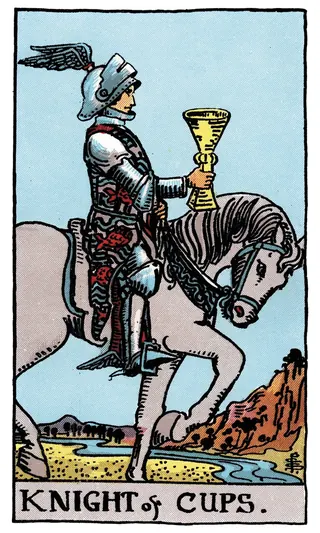
1. Your reason for texting — Knight of Cups
The Knight of Cups evokes an emotional approach. Here it asks you to name the purpose of reaching out rather than automatically pressing send.
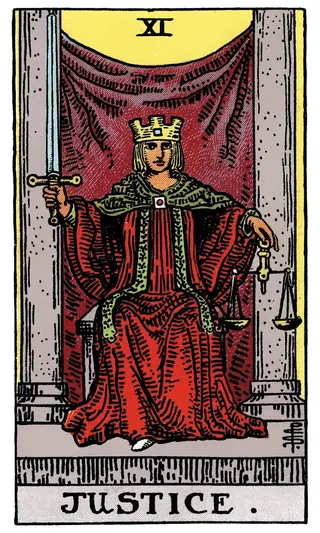
2. Whether contact is appropriate — Justice
Justice brings proportion and boundaries into focus. Consider whether another message would respect the existing conversation.
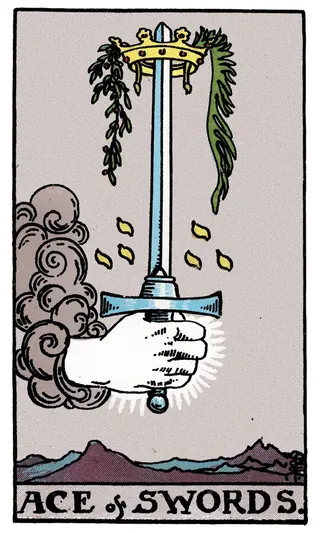
3. A message you can stand behind — Ace of Swords
The Ace of Swords suggests clarity. One concise invitation is easier to answer than a long message containing several unspoken expectations.
Put the example together
Connect your reason for texting with whether contact is appropriate, then use a message you can stand behind to identify something you can examine or do. Look for a shared theme and a tension between the cards. If a connection does not fit what you know, do not force it.
Try an alternative interpretation as well. A card about holding on could describe useful stability or fear of change; decide which fits the evidence rather than selecting the version you prefer.
How to read a reversal here
A reversed card uses the reversed keywords shown in your result. Read those themes through the same position. It does not automatically negate the upright card or turn the whole spread into a no. A theme of hesitation, for example, can prompt a question about your own uncertainty without identifying another person’s motive.
Learn more about reversed tarot cards. Use the full card meaning as context, not as a substitute for the facts of your situation.
Cards traditionally read as “go ahead and reach out”
For this question, readers tend to treat the cards below as a green light, provided there is no boundary in the way. They describe the tone a message could take, not how he will respond.
- Ace of Cups: an open heart; a warm, sincere message is in tune with the moment.
- Page of Cups: a light, playful note rather than a heavy confession.
- The Magician: you have the words and the skill; say it plainly.
- Ace of Swords: clarity; send one honest sentence instead of a paragraph of hints.
- Eight of Wands: quick communication and messages in motion.
- Two of Cups: a two-way connection where reaching out feels mutual.
- The Fool: a small, brave leap without overplanning the outcome.
- Page of Wands: enthusiastic first contact, such as an invitation to do something specific.
- The Sun: openness and honesty with nothing to hide.
- Three of Cups: friendly, social contact; keep it relaxed.
Cards read as “wait” or “not this message”
A caution card does not mean “never.” In a texting spread it usually means “not like this” or “not tonight,” and it gives you time to send something you will still stand behind tomorrow.
- Four of Swords: rest first; a message sent while exhausted or upset rarely lands well.
- The Hanged Man: pause and look at the situation from another angle.
- Five of Swords: a text written to win an argument will likely deepen the conflict.
- Seven of Cups: you may be texting a fantasy rather than the real person.
- Nine of Swords: anxiety is driving the urge; wait until it settles.
- Knight of Swords: impulsive, sharp words you may regret by morning.
- The Devil: a compulsive pull; check whether this is a pattern you want to break.
- Eight of Cups: walking away may serve you better than reopening the thread.
- Temperance: moderation; perhaps one message, but not three in a row.
- The Tower: a volatile moment; sudden disclosures may cause more damage than relief.
When your draw is split between yes and wait
Picture a draw of the Page of Wands, the Four of Swords and the Ace of Swords. The first card wants to act, the second says rest, the third says be clear.
Rather than picking the card you like best, let the three cards shape a sequence:
- The Page of Wands confirms there is genuine interest behind the impulse.
- The Four of Swords asks you to wait a day, sleep on it and reread your draft with fresh eyes.
- The Ace of Swords says that when you do send it, keep it short and specific, like a simple question or an invitation with a time.
Seen this way, a mixed spread does not mean the cards are confused. It means “yes, but not in the state you are in right now.” If you cannot imagine feeling calm about any reply, including no reply, that is your signal to wait longer.
Is there a right time to text him?
Tarot cannot tell you the hour he will be free to answer. Some readers use symbolic conventions to talk about pace:
- Wands cards suggest acting soon, while the energy is fresh.
- Cups cards point to emotional readiness, which may take some days.
- Swords cards ask you to think first, and Pentacles cards favor slow, steady contact.
- The Two of Swords shows a stalemate where waiting does not help either; a decision is needed.
These ideas come from tradition, and practitioners disagree on details, so they are prompts for reflection rather than rules.
Practical timing matters more. Avoid texting late at night after drinking, in the middle of an argument or right after seeing something on social media that stung. Daytime, a calm mood and a clear purpose make a better window than any card. If your last message is still unanswered, the timing question is already answered for now.
Before you press send: a short checklist
- Check boundaries first. If he asked for space or no contact, do not text, whatever the cards show.
- Write the draft in your notes app, not in the chat window.
- Cut it to one purpose: a question, an invitation, an apology or a piece of information.
- Keep serious topics for a call or a meeting. A BYU study of 276 young adults in relationships linked using texts to apologize, argue or make decisions with lower relationship quality for women.
- Decide now what you will do if there is no reply in a few days.
Stop consulting the cards once you have a draft you are comfortable with; extra draws usually turn a simple message into a test. If you keep wanting to text someone who has hurt you, or you feel pressure to answer immediately when he texts, talk it through with a friend or a counselor. A love chat can help you put feelings into words.
Real-life signals that answer this better than cards
The question “should I text him” often has a practical answer hiding in your message history. Scroll back and look at the pattern rather than at any single exchange.
- Who starts conversations? If it is nearly always you, try waiting and see whether he reaches out.
- How does he reply? Questions back and follow-up plans show interest; one-word answers days later suggest low investment.
- Do plans happen? Texts that never turn into meeting up may mean the chat is filling time for him.
- How do you feel after? Calm and pleased is a good sign; checking your phone every few minutes is not.
If the history is balanced and warm, a friendly text is reasonable, whatever card appears. If it is one-sided, even the Queen of Wands in your spread, a card of confidence, would point toward investing that confidence somewhere it is matched.
Practical checks after this reading
- Write the purpose before writing the text.
- Check consent and the history of unanswered messages.
- Decide in advance that no reply will not trigger a series of follow-ups.
Record the cards, one possible interpretation and one fact that would help you evaluate it. If the draw does not fit, leave it aside. Repeating a draw until it feels reassuring does not make the result more informative.
Choose the question you actually mean
These related spreads examine different questions; one answer should not be used to settle the others.
More tarot readings by question
Love and attraction
- Does he like me?
- Does she like me?
- How does he feel about me?
- Is he thinking about me?
- Does he miss me?
- Will he text me?
- Is he the one?
- Will he commit?
- Will I find love?
- When will I meet my soulmate?
- Future husband tarot
- Will I get married?
Exes and second chances
- Will he come back?
- Will she come back?
- Does my ex still love me?
- Will my ex contact me?
- Will we get back together?
- Should I forgive him?
- Should I stay or leave?
Work, money and study
- Will I get the job?
- Will I get promoted?
- Should I quit my job?
- Should I change careers?
- Will my business succeed?
- Will my finances improve?
- Will I pass my exam?
Life decisions
Frequently asked questions
Can this reading answer “Should I text him?” with certainty?
This is a choice you can make, rather than an outcome you need to predict. Use the spread to examine why you want to send the message, whether contact would be welcome and what you want to say. The cards do not give permission to cross a boundary.
How is this spread different from the other readings?
This spread uses your reason for texting, whether contact is appropriate and a message you can stand behind. Its worked example and practical checks focus on this question. It does not use a generic yes/no score.
Does typing my question change the interpretation?
No. The optional note is for your own context. Cards are drawn at random in your browser, and the prompts are written for the positions on this page. No AI analyses your note in this tool.
What should I do with an unclear or uncomfortable reading?
Record one possible interpretation and compare it with what you know. If it does not fit, you can leave it aside. Another draw cannot establish a missing fact; use a conversation, records or other relevant information instead.
Method and further reading
This tool uses the site’s Rider–Waite–Smith card keywords with question-specific reflection prompts. It does not analyse your optional note with AI, infer hidden information or calculate the likelihood of an outcome. The worked example explains how to apply the positions.
Learn to read a complete tarot spread · All 78 card meanings · How our tools work
Sources cited on this page:
- Too much texting can disconnect couples, research finds · Brigham Young University News