After an application or interview, the outcome depends on information you may not have. This spread focuses on your evidence of fit, the unknowns in the selection and what you can do while waiting. It cannot predict the employer's decision.
For reflection and entertainment. Tarot and AI readings don't predict the future and aren't financial, medical, legal or psychological advice. Use them as a prompt to think, not as a decision.
Will I get the job? Draw your three cards
Free, no signup. Three distinct cards are drawn at random from the full 78-card deck. Each has a one-in-three chance of appearing reversed.
This random draw does not establish an outcome, reveal another person’s private thoughts or give a date. Use it as a prompt; check facts separately.
The three positions for this question
Set these positions before drawing. Read each card through its position instead of applying the same meaning to all three.
1. Evidence of your fit
Use this card to examine how your experience matches the stated role. Which examples show the skills the employer asked for?
2. What the selection does not reveal
Read the symbol as a reminder of unknowns: other applicants, approvals and priorities. What conclusion would go beyond the information you have?
3. Your next application action
Use this card to choose an appropriate follow-up, prepare for another stage or continue your search without assuming an outcome.
Keep this question in focus
A good interview feeling is not an offer, and a delay is not necessarily a rejection. Keep application facts separate from interpretations of tone or timing. The useful next step may be a proportionate follow-up or continuing other applications.
A complete example for “Will I get the job?”
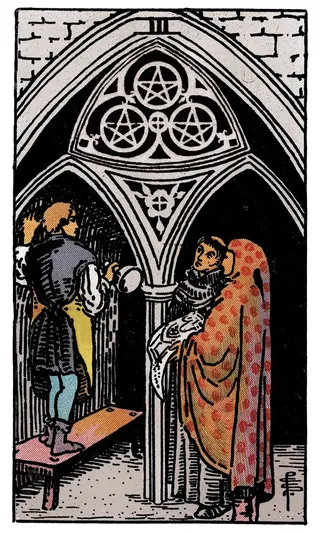
Evidence of your fit
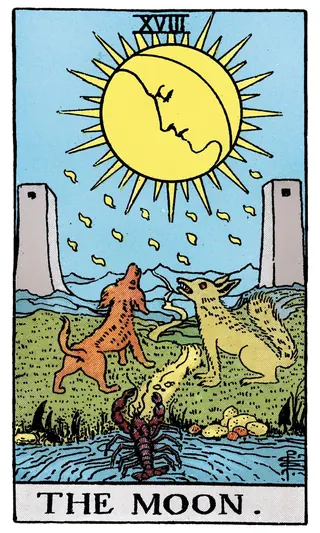
What the selection does not reveal
Your next application action
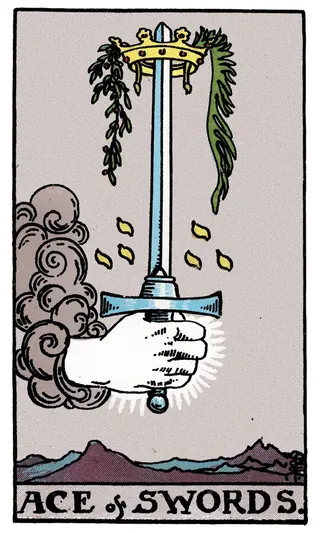
Pamela Colman Smith · Rider–Waite–Smith (1909)
These three upright cards are selected as an instructional example, not presented as a random draw or a recorded personal reading. Your own cards may differ; the method is to connect the symbol, position and context.
1. Evidence of your fit — Three of Pentacles
The Three of Pentacles suggests demonstrated work. In the first position, review which concrete examples you gave, rather than rating your chances from the symbol.
2. What the selection does not reveal — The Moon
The Moon represents incomplete information. It can remind you that silence from a recruiter does not explain the whole hiring process.
3. Your next application action — Ace of Swords
The Ace of Swords suggests a clear question. If the stated timeline has passed, a concise follow-up can ask about next steps without demanding a decision.
Put the example together
Connect evidence of your fit with what the selection does not reveal, then use your next application action to identify something you can examine or do. Look for a shared theme and a tension between the cards. If a connection does not fit what you know, do not force it.
Try an alternative interpretation as well. A card about holding on could describe useful stability or fear of change; decide which fits the evidence rather than selecting the version you prefer.
How to read a reversal here
A reversed card uses the reversed keywords shown in your result. Read those themes through the same position. It does not automatically negate the upright card or turn the whole spread into a no. A theme of hesitation, for example, can prompt a question about your own uncertainty without identifying another person’s motive.
Learn more about reversed tarot cards. Use the full card meaning as context, not as a substitute for the facts of your situation.
Cards traditionally read as a good sign for a job application
For career questions, readers lean on Pentacles for concrete offers, Wands for momentum and a few Major Arcana for recognition. These are the cards most often called encouraging after an interview, keeping in mind that the hiring decision belongs to the employer:
| Card | Why it reads as encouraging here |
|---|---|
| Ace of Pentacles | A tangible new offer or contract; the classic "job offer" card. |
| Six of Wands | Recognition and standing out among candidates. |
| Eight of Wands | Fast communication: a callback, an email or a next round arriving quickly. |
| The Sun | Clarity and success; your strengths were visible. |
| Eight of Pentacles | Skill and diligence that match the role. |
| The Magician | You have the tools; preparation for the next stage pays off. |
| Page of Pentacles | A learning opportunity or entry-level start with growth potential. |
| The Chariot | Determination and forward movement in a competitive process. |
| Nine of Cups | A wish fulfilled; often read as a straightforward yes in career spreads. |
| Queen of Pentacles | Practical competence and someone who values your reliability. |
Cards that suggest a delay, a no, or a better-fitting role
A cautious card after an interview is disappointing, but rejection is a normal part of searching, and these cards often point toward preparation or a different opportunity rather than failure.
- Five of Pentacles: a missed chance or a gap in the offer; something may not line up this time.
- Four of Pentacles: stalled process; approvals or budgets may be holding things up.
- Seven of Cups: too many options or an unclear picture of what the role really is.
- Five of Wands: competition among strong candidates; the outcome may depend on factors beyond you.
- Seven of Wands: having to defend your position; prepare to answer tough follow-up questions.
- Nine of Swords: worry keeping you up at night; the fear may be louder than the facts.
- Ten of Swords: an ending; this door may close so another can open.
- The Hanged Man: a waiting period or a need to see the role from another angle.
- Justice: a fair decision based on criteria; if it is a no, ask for feedback.
Making sense of a mixed job reading
Imagine your three cards are Knight of Pentacles for evidence of your fit, Two of Swords for what the selection does not reveal and Page of Swords for your next application action.
The Knight of Pentacles says your strongest asset is reliability; your examples probably showed someone thorough and steady. The Two of Swords in the unknowns position fits a hiring team that has not decided yet, perhaps weighing two finalists. The Page of Swords as an action is about curiosity and alertness: research the team further, prepare sharper questions for a possible next round, and keep scanning listings.
That reading neither says you got the job nor says you did not. It tells you where you stand and what keeps you moving. If you are torn about whether this role is even the right step, the career change or promotion spreads ask a different question and give a different kind of answer.
When will I hear back? Tarot timing versus hiring timelines
Some readers assign speed to suits: Wands fast, Swords and Cups in between, Pentacles slow and bureaucratic. The Eight of Wands is often read as quick news, and the Four of Swords or the Hanged Man as a pause. These are traditions, and readers do not agree on them, so no card can tell you which day the email arrives.
Hiring timelines depend on things you can actually ask about: the number of interview rounds, who signs off, and whether the role is still budgeted. If the interviewer gave a date, use that as your reference point. If not, it is reasonable to ask about the next steps in your follow-up note.
Watch for real signals instead of symbolic ones: a request for references, a scheduling email for another stage, or a question about your availability. Each of those carries far more information than any card about the hiring team's decision.
What to do while you wait for an answer
- Send a short thank-you note; CareerOneStop, sponsored by the U.S. Department of Labor, recommends writing it soon after the interview, ideally the same day.
- Note which questions felt weak and draft better answers in case there is another stage.
- Keep at least one other application or networking conversation active this week.
- If the date they gave passes, send one polite check-in rather than several.
- If you get a no, ask whether they can share feedback.
Stop drawing on this question once you have reflected on your next step; repeated pulls usually reflect nerves, not news. If job loss or a long search is affecting your sleep, money or mood, talk with someone you trust, a career counselor, or a mental health professional. For a focused conversation, there is also a career psychic chat.
Hiring signals that tell you more than any card
Recruiters rarely spell out where you stand, so it is natural to read meaning into everything. A few signs carry genuine weight, and several common worries do not:
- Meaningful: they ask about your salary expectations, notice period or start date, or arrange a meeting with future colleagues.
- Meaningful: the hiring manager describes the role in terms of "when you join" and explains the onboarding plan in detail.
- Weak: a friendly tone, a longer than scheduled interview, or a quick reply to your thank-you email.
- Weak: silence for a week; internal approvals, vacations and other candidates often slow things down.
- Clearer no: the posting is closed and a new hire is announced, or you receive a formal rejection.
If you notice yourself reading every delay as a Five of Pentacles, return to the facts you can verify and let the process run its course.
Practical checks after this reading
- Read the stated selection timeline and instructions.
- Prepare examples for any next interview stage.
- Keep other applications moving until you have an actual offer.
Record the cards, one possible interpretation and one fact that would help you evaluate it. If the draw does not fit, leave it aside. Repeating a draw until it feels reassuring does not make the result more informative.
Choose the question you actually mean
These related spreads examine different questions; one answer should not be used to settle the others.
More tarot readings by question
Love and attraction
- Does he like me?
- Does she like me?
- How does he feel about me?
- Is he thinking about me?
- Does he miss me?
- Will he text me?
- Should I text him?
- Is he the one?
- Will he commit?
- Will I find love?
- When will I meet my soulmate?
- Future husband tarot
- Will I get married?
Exes and second chances
- Will he come back?
- Will she come back?
- Does my ex still love me?
- Will my ex contact me?
- Will we get back together?
- Should I forgive him?
- Should I stay or leave?
Work, money and study
- Will I get promoted?
- Should I quit my job?
- Should I change careers?
- Will my business succeed?
- Will my finances improve?
- Will I pass my exam?
Life decisions
Frequently asked questions
Can this reading answer “Will I get the job?” with certainty?
After an application or interview, the outcome depends on information you may not have. This spread focuses on your evidence of fit, the unknowns in the selection and what you can do while waiting. It cannot predict the employer's decision.
How is this spread different from the other readings?
This spread uses evidence of your fit, what the selection does not reveal and your next application action. Its worked example and practical checks focus on this question. It does not use a generic yes/no score.
Does typing my question change the interpretation?
No. The optional note is for your own context. Cards are drawn at random in your browser, and the prompts are written for the positions on this page. No AI analyses your note in this tool.
What should I do with an unclear or uncomfortable reading?
Record one possible interpretation and compare it with what you know. If it does not fit, you can leave it aside. Another draw cannot establish a missing fact; use a conversation, records or other relevant information instead.
Method and further reading
This tool uses the site’s Rider–Waite–Smith card keywords with question-specific reflection prompts. It does not analyse your optional note with AI, infer hidden information or calculate the likelihood of an outcome. The worked example explains how to apply the positions.
Learn to read a complete tarot spread · All 78 card meanings · How our tools work
Sources cited on this page:
- Follow-up after interview · CareerOneStop (U.S. Department of Labor)